
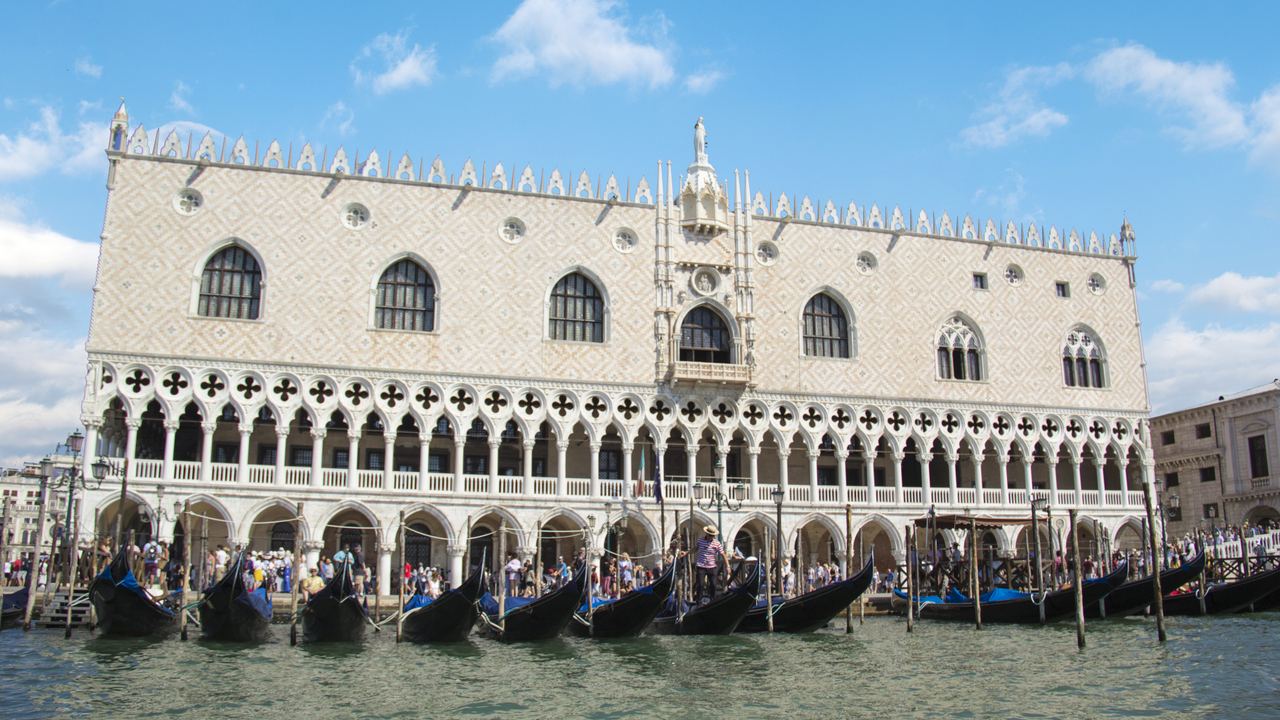
People look this up far more often than you would expect, and they are not usually settling an argument. They are about to spend money. The ticket says Schloss, or château, or palazzo, and the underlying question is practical: am I going to see walls, or am I going to see furniture?
The good news is that the institutional definitions are clear, they agree with each other, and they turn on something more useful than how military a building looks. The bad news is that our own catalogue, like every other, cheerfully files Versailles and the Doge's Palace under castles. That is worth explaining rather than hiding.
The definition that actually divides them
The obvious test, how military a building looks, fails immediately: Neuschwanstein looks far more warlike than a real fourteenth-century tower house and never repelled anything. The test that works asks two different questions. Who lived there, and who owned it?
The Getty Art and Architecture Thesaurus, which is the reference vocabulary museums and archives actually use, defines castles as buildings intended primarily to serve as a fortified residence of a prince or nobleman. The monument type thesaurus published by Historic England says much the same in fewer words: a fortress and dwelling, usually medieval in origin, often consisting of a keep, curtain wall and towers.
Notice that both definitions carry two ideas at once. Fortification and residence. Remove either and it stops being a castle: a fortification nobody lived in is a fort, and a residence with no defences is a house.
The same thesaurus defines a fortress as a large, permanent, heavily fortified defensive military position, sometimes including a town, and larger and stronger than a fort. Put the two entries side by side and the difference is not the thickness of the wall. It is that one says residence of a prince or nobleman and the other says military position. Private and lived in, against public and garrisoned.
Why a palace is not a castle with the weapons removed
This is the part that surprises people, and it is a fact about the classification rather than an opinion. In the Getty thesaurus, palaces do not sit under fortifications at all. They sit under residential structures, then dwellings, then houses, then official residences. Castles sit on the fortification branch. The two are not neighbours on the same shelf; they are different shelves.
The definition confirms it: palaces are official residences, frequently large and impressively appointed, of sovereigns or other high dignitaries, and the entry explicitly redirects other large stately dwellings that are not official residences to mansions. What makes a palace a palace is the office of the person living in it, not the architecture.
Which is why Buckingham Palace is a palace and Windsor Castle is a castle even though the same family uses both. One is a fortified site with a documented military past. The other is a ceremonial residence that has never been anything else.
Citadels, for completeness, are filed under fortresses rather than castles. A citadel is a fortified strongpoint inside a town, which makes it a military structure that happens to be urban.

The awkward cases are the interesting ones
The buildings that refuse the categories
Castel del Monte in Puglia is an octagon with eight octagonal towers, no moat, no barbican, no obvious defences and no evidence anyone lived in it for long. It has been read as a hunting lodge, an observatory, a treasury and a piece of geometry built to be looked at. It carries the word castel and satisfies almost none of the definition.
Cases like this are not failures of the scheme. They are the reason a scheme with two independent tests, ownership and use, works better than one that scores buildings on how fortified they look.
The languages that do the work for you
English has one word where several other languages have two, and those other languages will often tell you what kind of visit you are about to have before you read a single line of the description.
German is the most useful. A Burg is a medieval fortified building, a defensive work. A Schloss is an early modern lordly residence without a pronounced defensive character. The professional terminology dates the transition to the fifteenth century, when the priority shifts from defensibility towards display and comfort. This is not a subtlety: Neuschwanstein is a Schloss, and the German-speaking arguments about whether it is a real castle are, in part, an argument that English cannot even phrase.
French is the least useful, and its ambiguity is contagious. Château covers both, and the disambiguation is done by an adjective: a château fort is the fortified kind and a plain château is Chambord or Versailles. An English catalogue that files both under castles is importing a French ambiguity into a language that never had it, which is exactly what has happened across this industry, ours included.
Spanish splits it geographically. The Spanish academy defines an alcazaba as a walled enclosure inside a walled town, sheltering a garrison, which is a citadel in all but name. An alcázar is a fortress or a royal or princely residence, fortified or not, which is why the Alcázar of Seville is a palace and the Alcazaba of Málaga is a military work, and why the Alhambra contains both and is not really either.
The details of the vocabulary, across a dozen languages, are collected in the glossary.
What the historians argued about, and why it changed
For most of the twentieth century the standard account of the castle was military: a machine for defence, to be understood through fields of fire and lines of attack. That reading held for roughly a hundred years and has since been substantially revised.
The revision has an interesting explanation attached. It has been observed that the generation of scholars who established the military reading had, very largely, done military service themselves, and read the buildings with the training they had. The alternative was actually older: Ella Armitage, writing in 1912, described castles as private fortified residences of great landowners, which is close to what the reference vocabularies say today.
What tipped it was work on individual buildings that would not behave. Bodiam in Sussex is the famous case: a picturesque moated castle whose defences turn out to be, on close reading, more display than deterrent. Once one celebrated example was better explained as architecture of status, others followed.
The two findings on the myths page point the same way. Historic England's own scheduling text says the moat at most English moated sites was a status symbol rather than a practical defence, and the surviving licences to crenellate went mostly to minor knights for modest houses. Neither of those is a study of Bodiam, and both say the same thing.
What the word predicts about your visit
All of which is only worth knowing because it is predictive. Words are not a perfect guide, but they carry real information about the day ahead.
| The word | What it usually means | What the visit tends to be |
|---|---|---|
| Castle, Burg, castillo, hrad | Fortified residence, usually medieval in origin | Stairs, thick walls, and a decent chance of no roof |
| Palace, Schloss, palazzo, zámek | Official or lordly residence, usually early modern | Rooms, furniture, timed entry and no photography |
| Fortress, fort, citadel, alcazaba | Public military work, garrisoned | Walls, gun positions, a view, and very little interior |
| Château | Either. The adjective decides | Check for the words fort or Renaissance before booking |
| Alcázar | Fortress or royal residence, sometimes both | Usually the palace half is the ticketed part |
| Fort, in India | Frequently a walled town | A large site with several monuments inside it |
| Shiro, in Japan | Timber and plaster, often reconstructed | The authenticity question is about the rebuild, not the age |
Two rows deserve a note. The Indian fort is not a scaled-up castle: the UNESCO description of the hill forts of Rajasthan describes defensive walls, running in places to twenty kilometres, enclosing urban centres, palaces, trading centres and temples. That is a walled city, and it wants a day rather than an hour.
And the Japanese case moves the whole question sideways. Himeji is celebrated as a masterpiece of construction in wood, with white plastered earthen walls. In a tradition where the material is timber, the argument about authenticity is never about how old the stones are; it is about whether the reconstruction was done in wood or in concrete. Which is the local version of the question the rest of this catalogue asks as ruin, reconstruction or furnished palace.
So why is Versailles in a castle catalogue?
Because the categories that organise a thesaurus and the categories that organise a trip are not the same thing, and it is more honest to say so than to pretend the definition stretches.
Versailles is a palace. The Doge's Palace is a palace. The Forbidden City is a palace complex. None of them is a castle under any definition on this page. They are here because they answer the same question a traveller is actually asking, which is where the great secular buildings are and how you get inside them, and because a visitor who has just done Chambord is far more likely to want Chenonceau next than a Norman motte.
Where the distinction does earn its keep is at the moment of booking, and that is the whole reason for this page. A palace means rooms, a fixed route and a camera you will not be allowed to use. A castle means stairs. A fortress means a view and a coat.
The difference, in short answers
What is the difference between a castle and a palace?
Ownership and purpose, not appearance. A castle is a fortified residence of a lord, private and defended. A palace is an official residence of a sovereign or high dignitary. In the Getty thesaurus they are not even on the same branch: castles sit under fortifications, palaces under houses.
Is a fortress just a big castle?
No. A fortress is a public military position, garrisoned rather than lived in, sometimes enclosing a whole town. A castle is somebody's home that happens to be defended. The Getty definitions make the split explicit: one says military position, the other says residence of a prince or nobleman.
What is the difference between a Burg and a Schloss?
A Burg is a medieval fortified building. A Schloss is an early modern lordly residence without pronounced defences. The shift begins in the fifteenth century, as priorities move from defensibility to display and comfort. German states plainly what English needs a sentence to explain, which is why Neuschwanstein being a Schloss is a real piece of information.
Does chateau mean castle?
It means either, and the adjective decides. A chateau fort is a fortified medieval castle; a chateau on its own is Chambord or Versailles. English catalogues that translate both as castle are importing an ambiguity French has and English does not.
What is an alcazar?
A fortress, or a royal or princely residence, fortified or not. An alcazaba is different and narrower: a walled enclosure inside a walled town, sheltering a garrison, which is a citadel in all but name. The Alhambra contains one of each.
Why does this site call palaces castles?
Because it is organised around the trip rather than around the taxonomy. Versailles, the Doge's Palace and the Forbidden City are palaces by any definition on this page. They are here because they are the buildings people are choosing between, and because the distinction that changes your day is not castle against palace, it is ruin against furnished interior.

The third category, made visible
What a fortress looks like when it is not pretending
Hohensalzburg sits on its ridge above Salzburg and is, in German, a Festung rather than a Burg or a Schloss. The word is doing exactly the work the thesaurus definition does: this is a military position, public and garrisoned, not somebody's fortified house.
Look at what that produces. Bulk rather than elegance, wall area rather than windows, and a site chosen for what it overlooks rather than for where it is convenient to live. A visit is a walk on defences with a view at the end, which is a completely different afternoon from the Doge's Palace at the top of this page, and the two words tell you so before you have read a line of description.
Data verified on. Definitions from the Getty Art and Architecture Thesaurus, the monument type thesaurus published by Historic England, the Spanish Royal Academy and UNESCO site descriptions.