
Ask a search engine whether castles are wheelchair accessible and you get an odd set of answers. The follow-up questions are about building regulations and about which country is most disability friendly. The results are mostly castle hotels, because the word castle plus the word accessible reads, to a search engine, as somewhere to sleep. Actual visiting is barely covered at all.
Meanwhile the monuments themselves publish the information, in careful and often blunt language, on pages that nothing links to. This page collects what they say. It does not soften any of it, because a castle that is honest about being impossible to enter is doing something useful, and a page that rounds that off to partly accessible is not.
The two places that count their own steps
We checked whether the monuments in this catalogue publish a step count. Almost none do. Not Blarney, not the Belem Tower, not Bran, not Neuschwanstein, not Castel Sant'Angelo. Numbers circulate for several of them, they agree with each other, and none of them appears on the official site: a crawl of Neuschwanstein's own pages, in two languages and in archived versions going back a decade, contains no step count at all.
Two bodies are the exception, and the reason both are exceptions is the point of this page. Neither publishes the numbers as trivia. Both publish them in an access document.
Historic Royal Palaces gives the figures for the White Tower at the Tower of London: 247 steps in total; a trip round the upper floors and the basement takes in 206 of them, some irregular and very steep; there is a spiral staircase of 101 steps; and the total rise and fall is over 37.5 metres. Even getting through the door is counted, at eleven wooden steps to the first landing, twelve to the second, thirteen more and then five of stone.
Historic Environment Scotland does something rarer still at Stirling Castle, and publishes gradients rather than only counts. The approach is cobbled and sloping at a maximum of 1 in 15. The main route through the castle is 160 metres long, cobbled, at a maximum of 1 in 9. The Nether Bailey is 200 metres further on, down a cobbled track at up to 1 in 7. And the regimental museum inside the walls declares its own total: 114 steps.
Nobody writes any of that for fun. It is written for someone deciding whether they can do it. And it demonstrates that the information exists inside every one of these institutions; almost all of them simply decline to publish it.
What the monuments say about themselves
These are quotations and close paraphrases of official access statements, gathered on the same day. They are grouped by how much they rule out.
| Monument | What the official statement says | The practical reading |
|---|---|---|
| Blarney Castle | The castle is not accessible | Gardens only. The clearest statement in the survey |
| Trim Castle | The keep is not accessible; the stairs are very steep and narrow | The grounds work, the tower does not |
| Tower of London | Difficult stairs and passageways, including spiral staircases; wheelchair access is limited; many steps, cobbles, some low doorways | Parts of the site are fine, the White Tower is not |
| Hampton Court | Large amounts of uneven flooring and staircases; wheelchair access restricted in some areas; gravel, cobbles and flagstones | Surface, not just stairs. Relevant to walking sticks too |
| Stirling Castle | Cobbled and sloping approach at up to 1 in 15; main route 160 m at up to 1 in 9; four manual wheelchairs; a mobility vehicle to the Inner Close on request | The best-quantified access statement we found anywhere |
| Buckingham Palace | The standard admission route is not step-free | A step-free route exists but has to be arranged in advance |
| Neuschwanstein | For fire safety, one person in a wheelchair or with a walking frame per hour | The hardest constraint here, and a booking problem rather than a building one |
| Prague Castle | Barrier-free throughout, except the White Tower, Daliborka, the Powder Tower, the great south tower of the cathedral and the defensive corridors of Golden Lane | The best-documented complex. What is excluded is named |
| Castelo dos Mouros | Accessible within the walls, with particular care on the sections of steep gradient | The parapet walk itself is the inaccessible part |
| Castelo de Sao Jorge | An accessible route with an evened surface as far as the eastern belvedere | You reach the view, not the whole circuit |
| Petit Trianon, Versailles | The first floor is not accessible; a multimedia room stands in for it | An honest substitution, and rare |
| Schonbrunn | Accessible, with a lift to the first floor | The clear exception in this catalogue |
Two rows deserve a note for method rather than for generosity. Prague Castle, instead of saying partially accessible, names the five places that are not. And Stirling gives distances and gradients for every leg of the route, plus what it can lend you: four manual wheelchairs, a mobility vehicle to the Inner Close on request, and ear defenders at the ticket desk.
That is the format every heritage body should use, because it lets a visitor plan a real day rather than abandon one. It is also, on this evidence, rare enough to be worth naming when it happens.

Before the building begins
The gradient is the barrier, not the door
Neuschwanstein is the case where the hard part happens before the castle. The road up from the ticket centre is about a kilometre and a half of asphalt, described by the palace administration as a constant and in places steep climb. The footpath from the bus covers 500 metres at a gradient of 12 to 19 per cent. The last stretch from the horse carriage is 450 metres reaching 15 per cent.
Those are numbers that decide a day for anyone with a heart or breathing condition, a knee, or a toddler, and they have nothing to do with whether the building has a lift. Palazzo Pitti has the same problem in miniature: the entrance from Piazza Pitti climbs at about twenty per cent. At Windsor it is roughly ten minutes from the admission centre to the cloakroom, largely uphill, and then a flight of stairs.
Why castles are the hardest category
None of this is negligence by the institutions. A castle is a building type designed, with considerable ingenuity, to be difficult to move through. The features that made it work are exactly the features that make it inaccessible now.
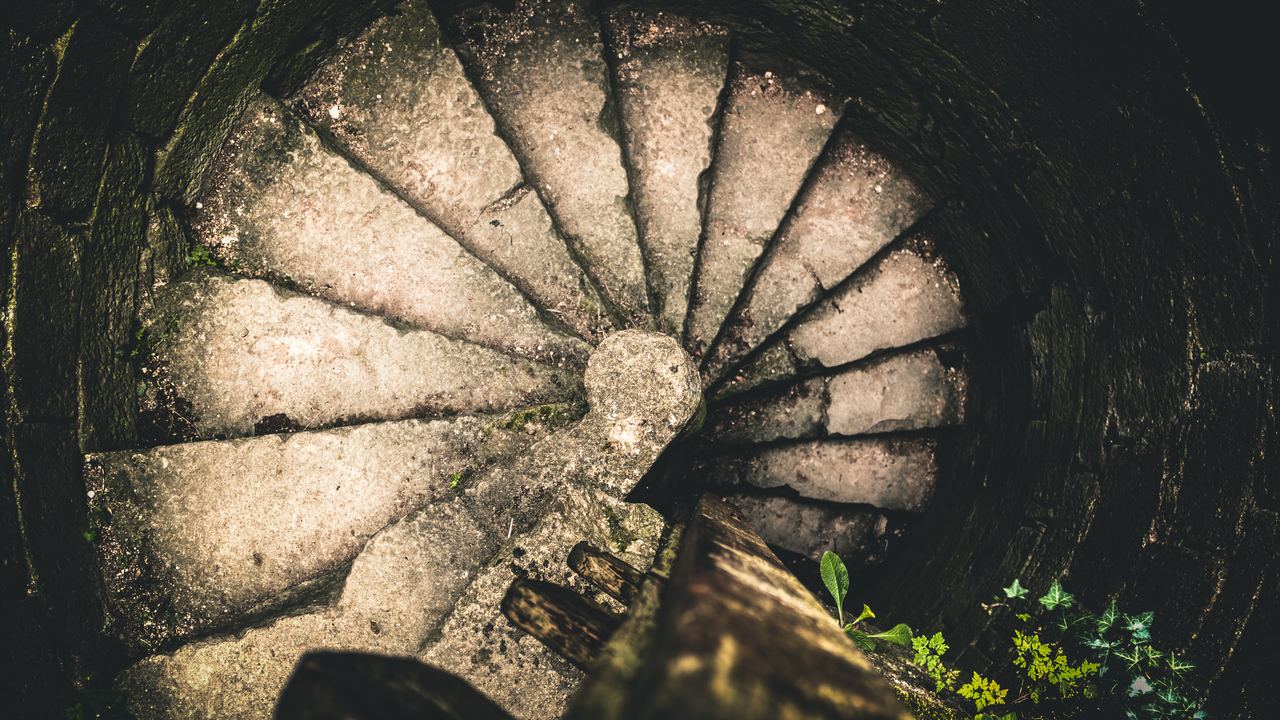
The spiral stair is the clearest example. It exists because a tower is round and a straight flight will not fit, and it produces treads that are wedge-shaped: wide at the wall, almost nothing at the centre. There is no handrail on the open side of a medieval newel stair because there was never meant to be one. Low doorways, which the Tower of London specifically warns about, are a defensive detail that survives as a head injury. Cobbles were a drainage solution. The hill was the whole point.
Retrofitting is possible and expensive, and the results are visible where it has been done. Schonbrunn is a palace rather than a fortress: level ground, wide stairs and a lift, and it works. Prague Castle is barrier-free almost everywhere because most of what a visitor sees there is early modern rather than medieval. The pattern is consistent across this catalogue: the closer a building is to being a real fortification, the less of it can be opened up.
What the tour listings declare
The tours on this site carry accessibility flags set by the operator, and reading them across the whole catalogue gives a second picture, this time of the guided product rather than the monument.
Roughly a quarter of the listings are flagged as wheelchair accessible, and a smaller share again declares specifically that the transport is wheelchair accessible or that the surfaces are. Those two flags matter more than the general one, because a tour whose coach is accessible and whose destination is a hill has not solved anything.
The physical difficulty flags are the ones to read sceptically. The overwhelming majority of listings are marked as suitable for all fitness levels, a large minority as moderate, and a tiny handful, no more than a few in the entire catalogue, as physically demanding. Given that the same catalogue includes Neuschwanstein, Peles and half a dozen hilltop ruins, that distribution says more about how operators fill in forms than about how hard the days are. Treat the flag as a floor and check the monument yourself.
The most useful flag is the dullest: roughly a fifth of listings note that public transport is nearby, which is often the fastest way to tell whether an independent visit is realistic.
How to check before you commit
Four questions, in this order, settle almost every case.
How do I get from the car park or station to the gate? This is where the gradient lives, and it is answered on the monument's directions page rather than its access page. Look for a distance in metres and a percentage.
Which specific parts are excluded? A site that answers this by name, as Prague Castle does, is telling you a day is still possible. A site that says partially accessible and stops is not telling you anything.
Is there a limit on numbers? Rare, but it exists and it is invisible until you book. Neuschwanstein's one wheelchair user per hour is a fire regulation, not a capacity guess, and it cannot be negotiated at the door.
Does the step-free route need arranging in advance? At Buckingham the standard route is not step-free and the alternative is booked separately. Assume this is the case unless the site says otherwise.
And a fifth question that applies to everyone rather than only to visitors with a declared disability: is there anywhere to sit? Castle interiors are almost entirely without seating, and a ninety-minute visit on stone floors is harder than most people expect.
Access questions the monuments themselves answer
Are castles wheelchair accessible?
Some parts of some castles are. Schonbrunn has a lift and works. Prague Castle is barrier-free apart from five named towers and passages. The Tower of London describes its own access as limited, Buckingham's standard route as not step-free, and Blarney states plainly that the castle is not accessible. Grounds and gardens are usually far more accessible than the buildings.
How many steps are there in a castle?
Almost none of them will tell you. The exception is the White Tower at the Tower of London, where Historic Royal Palaces publishes 247 steps in total, 206 on the standard route, a spiral staircase of 101, and over 37.5 metres of rise and fall. It appears in their access guide rather than their history pages.
Which castle is the hardest to reach?
Neuschwanstein, for reasons that begin before the building. The approach is about 1.5 km of road at a constant and sometimes steep gradient, the bus footpath runs at 12 to 19 per cent, and the interior admits one wheelchair user or walking frame per hour on fire safety grounds.
Can I take a pushchair into a castle?
Often not into the interior. Windsor bans pushchairs from the State Apartments. Anywhere with a spiral stair will effectively rule one out even where it is not formally banned. Ask whether the site lends baby carriers, because several do and few advertise it.
Are the tour listings reliable on accessibility?
Only partly. About a quarter of the listings in this catalogue are flagged wheelchair accessible, but the physical difficulty flags are unconvincing: nearly everything is marked suitable for all fitness levels, in a catalogue full of hilltop ruins. Use the flag as a starting point and confirm on the monument's own access page.
Which castle handles access best?
Schonbrunn for the building, and Prague Castle for the documentation. Schonbrunn is genuinely accessible with a lift. Prague does the more useful thing for planning: instead of hedging, it names the five places you cannot go.

The one that works
What accessible actually looks like
Schonbrunn is the clear exception in this catalogue, and the photograph explains why before any access statement does. Level ground, a gravel parterre with no gradient worth the name, a single wide facade, and a lift to the first floor where the state rooms are.
It is not that the Habsburgs were thoughtful. It is that this was never a fortification. Nothing here had to be hard to move through, so nothing is. The pattern holds right across the catalogue: the closer a building is to being a real fortress, the less of it can be opened up, and the more a palace it is, the better it works.
Which is a useful shortcut when you are planning for someone who cannot manage stairs. Look for the word palace, and be sceptical of the word castle.
Two further pages matter when you are planning around mobility. What a ticket actually opens identifies the ruins, which are almost always the hardest ground. And castles by train gives the distance and gradient from the station, which at several monuments is a harder obstacle than the building itself.
Data verified on. Access statements, gradients and step counts taken from the official pages of each monument. Where no step count is published we say so rather than repeating figures that circulate without a source.