
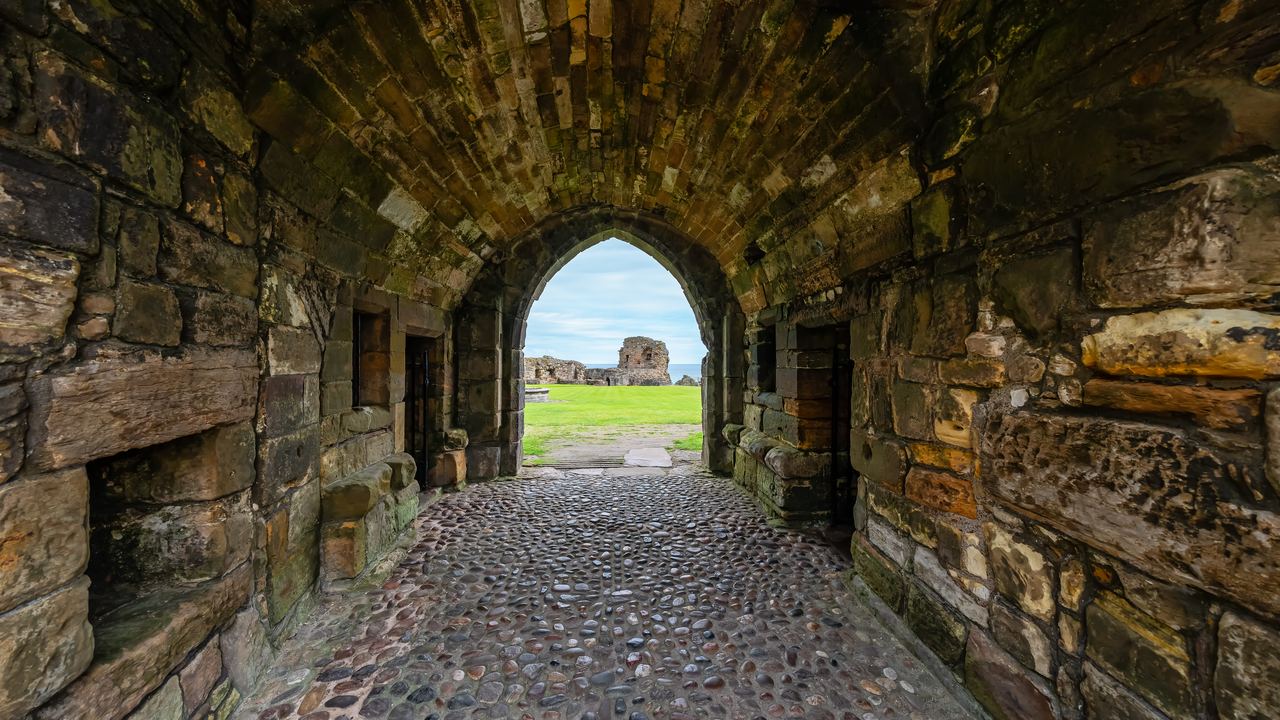
There is no shortage of advice about what to wear to a castle, and most of it is fine: comfortable shoes, layers, something for the rain. You do not need another page telling you that.
What is genuinely hard to find, and what will actually stop you at a door, is the rules. Every monument has them, every monument publishes them somewhere on its own website, and nobody collects them. We checked around twenty official sites and found bag limits given in centimetres, photography bans that vary room by room inside the same building, one castle with no bag storage at all, and exactly one that tells you what to put on your feet.
Bags: the rule that turns people away
This is the one to read before you leave the hotel, because it is the only rule on this page with no workaround once you are standing in the queue. Three monuments publish an actual measurement, which makes them unusually easy to plan for, and they do not use the same unit.
Buckingham Palace is the strictest and the most precise: bags larger than 45 by 20 by 30 centimetres cannot be taken into the Palace at all. Not checked in, not stored, not carried. There is no cloakroom, and the Palace points visitors at a left-luggage office in a railway station. Even a permitted bag has to be carried at your side rather than worn on your back.
The Doge's Palace in Venice uses a different and rather elegant measurement: the sum of the three dimensions, handles, wheels and outside pockets included, must come to under one linear metre. Bags over that go in the cloakroom, which is free.
Stirling Castle uses a third unit again, and it is the one a walker will recognise: suitcases and rucksacks of 30 litres or over are not permitted. Like the Tower of London, it cannot store anything for you, and it says so about prams and pushchairs as well as luggage.
That leaves the Tower as the one that catches people out, because it does the opposite of what a major attraction is expected to do. There is no left luggage and no bag storage of any kind; visitors must keep their belongings with them at all times, and suitcases and wheeled bags are not admitted. Everyone's bag is checked on the way in. Arrive with hand luggage and you have a problem with no solution inside the walls.
Windsor bans large backpacks and pushchairs from the State Apartments and provides a cloakroom for them. Palazzo Pitti requires umbrellas, large backpacks and bulky bags to be deposited, without giving a measurement.
One warning about a source rather than a rule. The cloakroom page at Versailles still carries text about a temporary closure for health reasons and about backpacks being exceptionally tolerated, which is language left over from the pandemic years. It is plainly stale, and we have not treated it as the current rule. If your day depends on it, ask on arrival.
Cameras: four regimes, and one everybody gets wrong
Photography rules inside castles are not a spectrum from strict to relaxed. They are four genuinely different systems, and knowing which one you are in changes what is worth carrying.
| Regime | Where it applies | What it means in practice |
|---|---|---|
| Banned outright, indoors | Buckingham Palace, Neuschwanstein | No private photography or filming anywhere inside. At Buckingham this includes the garden tour |
| Banned in named rooms only | Tower of London, Windsor, Prague Castle | Tower: no photography in the Jewel House and Martin Tower, permitted elsewhere without flash. Windsor: banned in the State Apartments and St George's Chapel, including wearable devices |
| Allowed, but no flash and no support | Alhambra, Schonbrunn, Quinta da Regaleira | The commonest regime, and the one people assume is a ban. Schonbrunn generally permits photography in the state rooms |
| Allowed free, charged if professional | Peles Castle | Amateur photography without flash costs nothing. Professional work is charged by the hour, indoors and out |
| Licence sold at the door | Prague Castle, in the buildings where it is not banned | A licence is purchased, and even with it flash and tripods stay prohibited |
Two practical consequences. First, a tripod is close to useless on a castle trip: it is banned at the Alhambra, Schonbrunn, the Regaleira and at Prague Castle even for licence holders, and selfie sticks go with it. Second, the widely repeated claim that Schonbrunn forbids photography is wrong. Its own visitor information says filming and photography are generally permitted in the state rooms. What it forbids is the flash, the tripod and the stick.
Drones are simply banned. Windsor states they are not permitted anywhere, and the same goes for Schonbrunn, Prague Castle, the Quinta da Regaleira and Neuschwanstein. Blarney's line is the most direct: as a private estate, this is not allowed.

What the building does to your bag
Narrow stairs decide more than the rules do
A stair tower like this one is why the bag rules exist. The treads are wedges, the wall is on both sides, and a rucksack worn on the back turns one person into an obstruction for everyone behind them. It is also why Buckingham asks visitors to carry a bag at their side rather than on their shoulders.
The same geometry rules out the pushchair. Windsor bans them from the State Apartments outright. If you are travelling with a small child, find out before you go whether the castle lends carriers, because the alternative is carrying both the child and the folded pushchair up something like this.
Shoes, and the one monument honest enough to say so
Almost every castle in this catalogue has cobbles, uneven paving or steps of inconsistent height. Exactly one publishes proper footwear advice, and because it is the only one, it is worth quoting rather than paraphrasing. The Alhambra tells visitors to wear comfortable shoes, preferably flat and closed, to avoid falls, slips and trips, especially on rainy or icy days, because parts of the site have uneven surfaces: stone paving, steps of different heights, and earth floors.
That description fits far more than the Alhambra. The Tower of London warns of many steps, cobbles and low doorways. Hampton Court warns of large amounts of uneven flooring, gravel, cobbles and flagstones. Buckingham Palace's exit is a long outdoor gravel path, which is a detail worth knowing if you were planning to end the visit in smart shoes.
The practical translation is short. Closed, flat and already broken in. Cobbles punish new shoes and any heel at all, wet stone in a castle courtyard is genuinely slippery, and the surface you are worried about is usually on the way out rather than on the way in.
What the tours themselves warn about
There is a second source for this, and it is the small print of the tours listed on this site. Operators attach practical notes to their own listings, and reading them across the catalogue shows what actually goes wrong often enough to be worth a warning.
The commonest by a distance is bring photo identification, which turns up on roughly one listing in seven and is easy to forget on a day trip inside your own continent. Next come the weather notes, about dressing in layers and bringing something for rain or sun, and then footwear, on a similar share of listings. Warnings about a lot of steps come next. Dress codes, timed entry, bag restrictions and long queues each appear on a small minority.
One detail from the same data is worth acting on. Every single Viator listing in this catalogue issues a mobile-only ticket. There is no paper fallback, which makes a charged phone a load-bearing part of the day, particularly on a long rural trip where you will also want the camera.
The short list
Everything above compresses into a small bag that will not be refused anywhere.
Carry a soft bag that fits within 45 by 20 by 30 centimetres, which clears the strictest limit in this catalogue and can be worn at your side. Bring photo identification, which more tours ask for than you would expect. Bring a power bank, because the ticket is on your phone. Wear closed flat shoes that are already broken in. Take a light waterproof rather than an umbrella, since umbrellas are among the first things a cloakroom takes off you. Leave the tripod and the selfie stick at home entirely.
Two things not to bring: a wheeled bag of any size, which the Tower of London will not admit and has nowhere to put, and a full-size pushchair if the visit includes state apartments.
And one expectation to adjust. Everyone packs for cold stone halls. The only monument in this survey that publishes a temperature warning warns about the opposite: Buckingham Palace notes that because the State Rooms open in the summer months, it can become very hot inside.
What they will and will not let through the door
How big a bag can I take into a castle?
The three published limits use three different units. Buckingham Palace draws the line at 45 by 20 by 30 centimetres and refuses anything larger outright. The Doge's Palace uses the sum of the three sides and stops at one linear metre. Stirling Castle bans rucksacks of 30 litres or more. A soft bag inside the Buckingham limit will pass everywhere.
Is there anywhere to leave luggage?
Sometimes, and at two of these monuments never. The Tower of London states there are no left luggage or bag storage facilities and does not admit suitcases or wheeled bags. Stirling says the same and extends it to prams and pushchairs. The Doge's Palace and Windsor do provide cloakrooms; Buckingham has none and points visitors to a railway station.
Can I take photographs inside?
It depends which of four regimes applies. Buckingham and Neuschwanstein ban private photography indoors completely. The Tower and Windsor ban it in named rooms only. The Alhambra, Schonbrunn and the Regaleira allow it without flash or tripod. Prague Castle sells a licence for the buildings where it is not banned outright.
Is a tripod worth carrying?
No. It is prohibited at the Alhambra, Schonbrunn, the Quinta da Regaleira and at Prague Castle even with a photography licence. Selfie sticks are treated the same way. Drones are banned everywhere we checked.
What shoes should I wear?
Closed, flat and already worn in. The Alhambra is the only monument in this survey that publishes the advice, and it explains why: stone paving, steps of different heights and earth floors. The Tower warns of cobbles and low doorways, Stirling's whole main route is cobbled and uphill, and Buckingham's exit is a long gravel path.
Will I need cash or a paper ticket?
Every Viator listing in this catalogue issues a mobile-only ticket, so a charged phone matters more than a printer. Some monuments run cash-only counters for extras, but that varies too much to state as a rule, so check the monument's own page for the day you are going.

The strictest door in this catalogue
No cloakroom, and a limit in centimetres
Buckingham Palace publishes the tightest bag rule we found anywhere, and it is unusually specific: nothing larger than 45 by 20 by 30 centimetres can be taken into the Palace at all. Not carried, not checked, not stored, because there is no cloakroom. The Palace directs visitors to a left-luggage office at a railway station.
Even a permitted bag has to be carried at your side rather than worn on the back, which is a rule about narrow rooms rather than about security. And the exit is a long gravel path through the garden, which is worth knowing if you had planned to finish the day in good shoes.
Two of the rules above depend on which kind of castle you are visiting rather than on which one. Ground and footwear are a much bigger question at a ruin than at a palace, and what a ticket actually opens tells you which you have booked. For the stairs, the gradients and who will struggle with them, see stairs and slopes.
Data verified on. Bag, camera and access rules read on the official site of each monument. The Versailles cloakroom page carries visibly outdated text and has not been treated as current.