
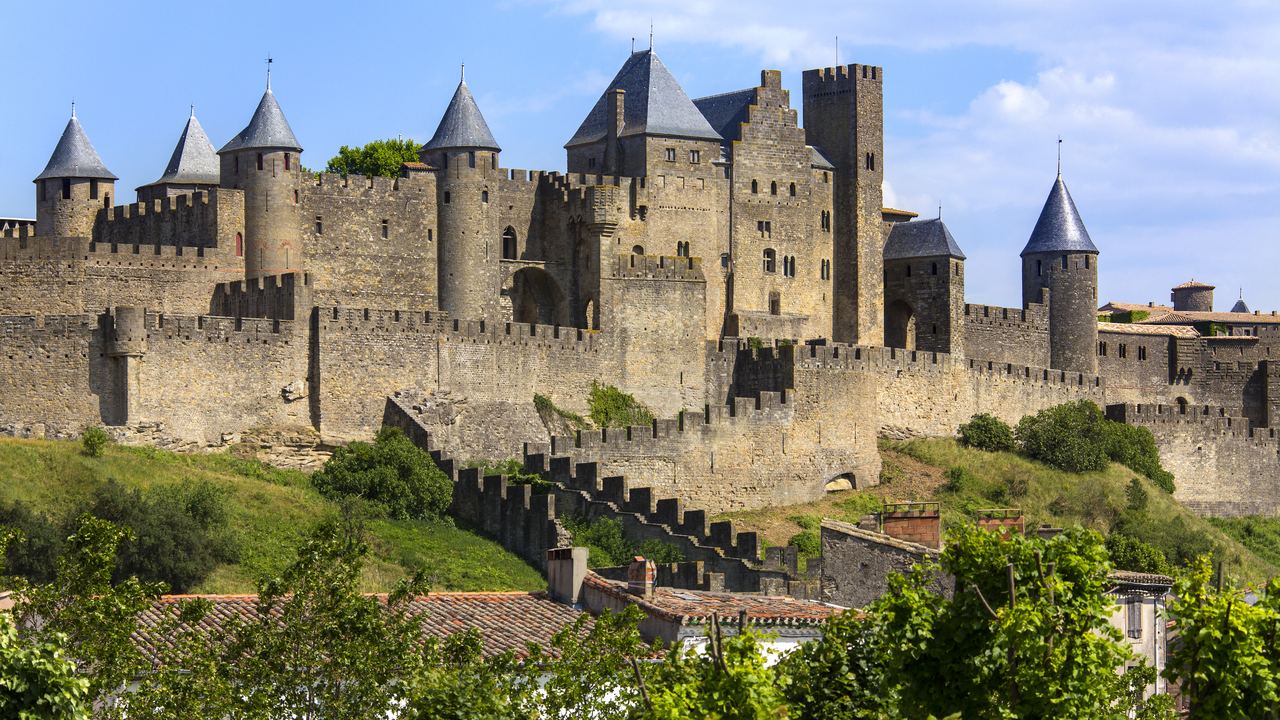
The word covers a thousand years and at least four completely different buildings. A mound of earth with a timber tower on it in the eleventh century; a concentric stone machine in the thirteenth; a comfortable moated house with decorative battlements in the fifteenth; and, in the nineteenth, a building with no military purpose at all, put up by people who missed the first three.
That last group matters more than it sounds, because a great deal of what we now buy tickets for belongs to it. The castle you are queueing at may be a genuine medieval fortress, or a Victorian idea of one, or a genuine medieval fortress substantially rebuilt by someone with a Victorian idea of one.
The arc, in twelve dates
Ordered by date. The groupings are ours; the dates come from the bodies that hold the buildings, except where a period is given as a century, in which case it is the conventional dating.
The origins
10th century
A mound, and a tower on it
The type begins in northern France as earth and timber: a raised mound with a tower on top and a defended yard beside it. Fast to build, requiring no masons, and possible almost anywhere.
1066
The type crosses the Channel
The Norman conquest carries the motte and bailey into England and Wales in numbers. Most were never rebuilt in stone, which is why the English countryside still has thousands of unexplained green mounds.
From about 1070
Earth gives way to stone
Stone building begins in earnest, and with it the newel stair. The earliest examples in the surveys of English and Welsh castle stairs date from this decade, which is as good a marker as any for when the type became permanent.
The growth
1199
Permission to have battlements
The first of roughly 463 licences to crenellate granted in England down to 1600. Most went to minor knights for modest manor houses, which tells you what they were really for: rank, not security.
1250 to 1350
The moat becomes a status symbol
The peak period for building the roughly six thousand moated sites known in England. Historic England's own description says the moat was intended as a status symbol rather than a practical military defence.
1283 onwards
The high point, and it was white
Edward I's castles in north Wales bring the vocabulary to its limit: barbicans, chicanes, concentric walls. And they were rendered. Cadw states that Conwy, now dark stone, was originally white.
15th century
From Burg to Schloss
The priority shifts from defensibility towards comfort and display. German marks the change with two different words, and the buildings follow: larger windows, better chimneys, battlements that are decoration.
16th century
Gunpowder flattens the walls
Artillery makes a tall wall a target rather than an obstacle. The answer is the opposite shape: low, thick, angular bastions set into the ground. The castle stops being current military architecture and becomes a house with a past.
Today
1719
Blown up
Eilean Donan is destroyed with barrels of gunpowder after a failed Jacobite landing, and lies in ruins for about two hundred years. A normal fate: most castles were ended by politics rather than by sieges.
1833 to 1837
The Romantic rebuild begins
Hohenschwangau, wrecked in the Napoleonic wars, is rebuilt in neo-Gothic style by Domenico Quaglio on the remains of the medieval castle, with more than ninety wall paintings. The nineteenth century has decided it wants castles back.
5 September 1869
A castle that was never a fortress
The foundation stone of Neuschwanstein is laid, in the valley below Hohenschwangau. It is brick faced with limestone, its throne hall is an iron frame with a skin on it, and its owner, in the palace administration's own words, only ever saw it as a building site.
July 1932
Rebuilt on the old plan
Eilean Donan is formally completed after two decades of work, rebuilt according to the surviving ground plan of the earlier phases. The plan is medieval; almost everything standing on it is not.
Why the first four centuries have almost vanished
There is a gap in the visitable record and it has a simple cause. The earliest castles were earth and timber, and timber does not last. The mound survives, because a mound is a landform; the tower on it does not.
This is why the English and Welsh countryside is full of grassy humps with a ditch round them that nobody signposts, and why almost every castle you can actually buy a ticket for is stone. It also explains the shell keep, which is a transitional solution you can still read on the ground: a stone wall built around the top of an existing motte to replace the timber palisade, because the mound could not carry the weight of a full stone tower.
So the visitable history of castles is not the history of castles. It starts about two hundred years late, at the point where the material changed.
The rare case
The ones that were never abandoned
A castle that has been continuously occupied looks very different from one that was not, and the difference is not maintenance. It is that an inhabited building keeps being modernised: new windows, new roofs, new wings, a staircase where a spiral used to be.
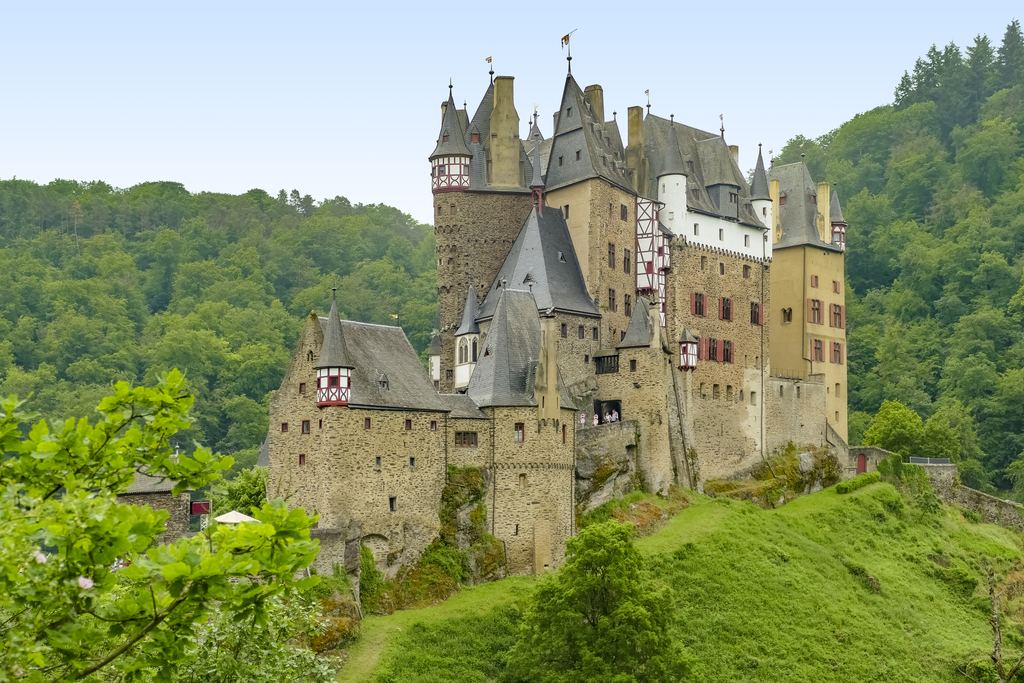
Burg Eltz in the Eifel is the classic example, held by the same family since the twelfth century and never sacked. So is Cawdor, near Inverness, whose tower is dated by its timbers to 1372 and which its owners still describe as a family home.
Which produces the paradox running through this whole subject. The castles that survived intact are the least medieval, because survival meant being changed. The ones frozen in their original form are the ones somebody stopped living in.
What gunpowder actually did
Cannon did not knock the castles down. Politics and neglect did. What gunpowder changed was the logic of building them.
Every defensive feature that mattered before artillery depended on height: high walls to climb, high towers to see and shoot from, machicolations to drop things through. Against a gun, height is a liability. A tall wall is a large target that cannot absorb impact, and it falls outwards, filling the ditch and making a convenient ramp.
The reply, worked out in Italy in the sixteenth century, inverts the shape. Walls become low and enormously thick, sunk into a ditch so that little of them is visible from outside; corners become angled bastions so that every face is covered by fire from another; the ground in front is smoothed into a glacis with nothing to hide behind. That is the star fort, and it is why late fortifications look like earthworks rather than buildings.
It also ended the castle as a private venture. A star fort is enormous, expensive and useless as a house, so it belongs to a state rather than to a lord. The building type that had been a fortified residence split back into its two halves: fortresses for governments, and country houses for everybody else.
The second life, and why it is on your ticket
Three hundred years later the castle came back, not as architecture but as an idea. The nineteenth century rebuilt, completed and invented them across Europe, and this is the single most under-explained fact in castle tourism, because it affects what visitors are actually looking at.
The pattern repeats with local variations. Hohenschwangau is rebuilt in the 1830s on medieval remains. Carcassonne is restored so thoroughly in the same century that the restoration is itself now the subject of debate. Karlstejn, near Prague, acquires what its own history page calls its present appearance in a purist restoration at the end of the century. Eilean Donan is rebuilt from rubble between 1911 and 1932. And Neuschwanstein is built from scratch as a stage set for a legend.
None of this is fraud and all of it is documented, usually by the institutions themselves. But it does mean that the medieval castle in the photograph is frequently a Victorian one, and that the argument about whether a castle is real, which flares up online about Neuschwanstein in particular, is really an argument about which century you thought you had booked.
That is why this site keeps a separate page on what a ticket actually opens. The date on the building is a better guide to the visit than the date in the story.
Where the type is now
Almost every castle in this catalogue is in its fourth life: not a fortress, not a residence, not a ruin left alone, but a managed heritage site with a timetable, a shop and a conservation plan. That is a real historical stage rather than an absence of one, and it shapes the visit as firmly as the defences ever did.
It explains the timed entry, which is a capacity measure for floors never meant to carry crowds. It explains the photography bans, which are usually about light and about wear on textiles. It explains why the ruins are so tidy: consolidation is a conservation technique, which is why Historic Environment Scotland's word for what remains at Urquhart is ruins rather than rubble.
And it explains the one thing visitors most often find strange, which is that the castle is often less atmospheric than they expected. A building being looked after is a building with handrails, signage and a fire exit. The alternative, over a thousand years, has generally been to fall down.
The dates people ask about
When were castles built?
The type begins around the tenth century in northern France as earth and timber, crosses to England in numbers after 1066, and is rebuilt in stone from about 1070. Serious castle building runs to roughly the sixteenth century, when gunpowder makes tall walls obsolete. After that, what gets built is either an artillery fortress or a country house.
Why are there so many grassy mounds and so few early castles?
Because the first ones were earth and timber. The mound survives because it is a landform; the tower does not. Most mottes were never rebuilt in stone, which is why the visitable history of castles effectively starts two centuries after the actual history does.
Did cannons destroy the castles?
Rarely directly. What gunpowder destroyed was the logic of building them: against artillery, height is a liability, so walls became low, thick and angular, sunk into the ground. Most castles were ended by politics, neglect or a deliberate demolition, as at Eilean Donan in 1719.
How much of a famous castle is actually medieval?
Often less than the photograph suggests. Hohenschwangau was rebuilt in the 1830s, Karlstejn took its present appearance in a late nineteenth-century restoration, and Eilean Donan was rebuilt from ruins between 1911 and 1932. The institutions publish this themselves; almost no ticket page repeats it.
Which castles are the most authentically medieval?
Usually the ruins, which is the paradox of the subject. A castle that stayed occupied kept being modernised, so the intact ones are the least medieval. The ones frozen closest to their original form are the ones somebody stopped living in.
What was the last real castle?
There is no clean answer, because the type does not end so much as split. By the sixteenth century the defensive function has gone to the artillery fortress, which belongs to a state, and the residential function to the country house, which belongs to a family. German marks the moment in its vocabulary: the fifteenth century is when Burg starts giving way to Schloss.

The century that gave us the castle back
1833, and the shape of everything after it
Hohenschwangau, in the valley below Neuschwanstein, is the hinge of the second half of this timeline. Wrecked in the Napoleonic wars, it was rebuilt between 1833 and 1837 by Domenico Quaglio on the remains of the medieval castle, with more than ninety wall paintings coordinated with the furniture.
What matters is not the building but the decision. A ruined castle was worth rebuilding, as a castle, for a family that had no military use for one. Within a generation the same impulse produced Neuschwanstein up the hill, the restoration of Carcassonne in France, the purist rebuilding of Karlstejn in Bohemia and, eventually, the raising of Eilean Donan from two centuries of rubble.
Which is why so many of the castles in this catalogue are, structurally, nineteenth-century buildings with medieval foundations.
Data verified on. Dates from the body that holds each building, plus Historic England on moated sites and the catalogue of licences to crenellate. Century datings are conventional and labelled as such.