

Ask the internet when to visit a castle and you get a paragraph about pleasant spring weather. That is not the question people are actually asking. Search suggestions for a dozen famous castles all end the same way, and the ending is not in spring or in autumn: it is open in winter. Neuschwanstein, Bran, Edinburgh, Warwick, Windsor, Alnwick, Malbork. The worry is not that it will rain. The worry is that you will travel there and find the gate shut, or the last admission an hour before you arrive.
So this page does the season in the order that matters. First whether the place is open at all, then how much daylight there is to spend, and only then the weather, which for most castles decides the comfort of the visit rather than its existence.
Winter does not close castles. It shortens them.
Very few of the monuments in this catalogue shut for the season. What almost all of them do is run a second timetable, and the second timetable is shorter at both ends. Neuschwanstein is the clean example: nine to six from late March, ten to four from the middle of October. That is eight hours of castle in summer and six in winter, on a day when the journey there takes the same time either way.
The trap inside the trap is the ticket office, which closes before the castle does. At Neuschwanstein the counter shuts two hours ahead of the gate. Arrive at four on an August afternoon and you will find an open castle you cannot buy your way into. Most monuments do some version of this, usually with a last admission thirty to sixty minutes before closing, and it is the commonest way a castle day goes wrong.
Two other winter effects are worth knowing before you plan around them. Outdoor sections close independently of the building: bridges, viewpoints, gardens and parapet walks come off the ticket when they are icy, while the interior stays open. And a handful of national holidays close everything, in patterns that do not match between countries. Neuschwanstein lists 24, 25 and 31 December and 1 January. Linderhof, an hour away and run by the same administration, also closes on Shrove Tuesday. Neuschwanstein does not. Details like that only matter once, and then they matter completely.
The light runs out before the castle closes
This is the part of seasonality nobody writes down, and it is the part that never changes. Daylight is astronomy. The table below will be as true in 2050 as it is today, which is more than can be said for any opening-hours page on the internet.
The consequence is blunt. In the Scottish Highlands in mid December, the sun sets at half past three. A castle that closes at four in winter is not being mean: it is closing after dark. An eight-hour day trip leaving at nine in the morning spends its last two hours in the dark, and a ruin with no interior, which is most of what the Highlands sell, becomes unphotographable and largely pointless.
| Month | Scottish Highlands | Prague | Granada | Beijing |
|---|---|---|---|---|
| January | 7 h 19 (08:47 to 16:06) | 8 h 33 | 9 h 53 | 9 h 39 |
| February | 9 h 30 | 10 h 07 | 10 h 51 | 10 h 42 |
| March | 11 h 47 | 11 h 51 | 11 h 56 | 11 h 54 |
| April | 14 h 20 | 13 h 47 | 13 h 09 | 13 h 15 |
| May | 16 h 36 | 15 h 26 | 14 h 10 | 14 h 22 |
| June | 17 h 59 (04:18 to 22:17) | 16 h 21 | 14 h 42 | 14 h 59 |
| July | 17 h 22 | 15 h 57 | 14 h 28 | 14 h 44 |
| August | 15 h 18 | 14 h 30 | 13 h 36 | 13 h 46 |
| September | 12 h 49 | 12 h 39 | 12 h 26 | 12 h 29 |
| October | 10 h 23 | 10 h 47 | 11 h 16 | 11 h 11 |
| November | 8 h 01 | 9 h 03 | 10 h 11 | 10 h 00 |
| December | 6 h 38 (08:53 to 15:31) | 8 h 06 | 9 h 37 | 9 h 22 |
Read the first and third columns together and the whole northern-southern difference falls out of one ratio. The Highlands swing from 6 h 38 to 17 h 59, a factor of 2.7. Granada swings from 9 h 37 to 14 h 42, a factor of 1.5. A Scottish castle has a season because of light. An Andalusian one does not, and its season comes from somewhere else entirely.
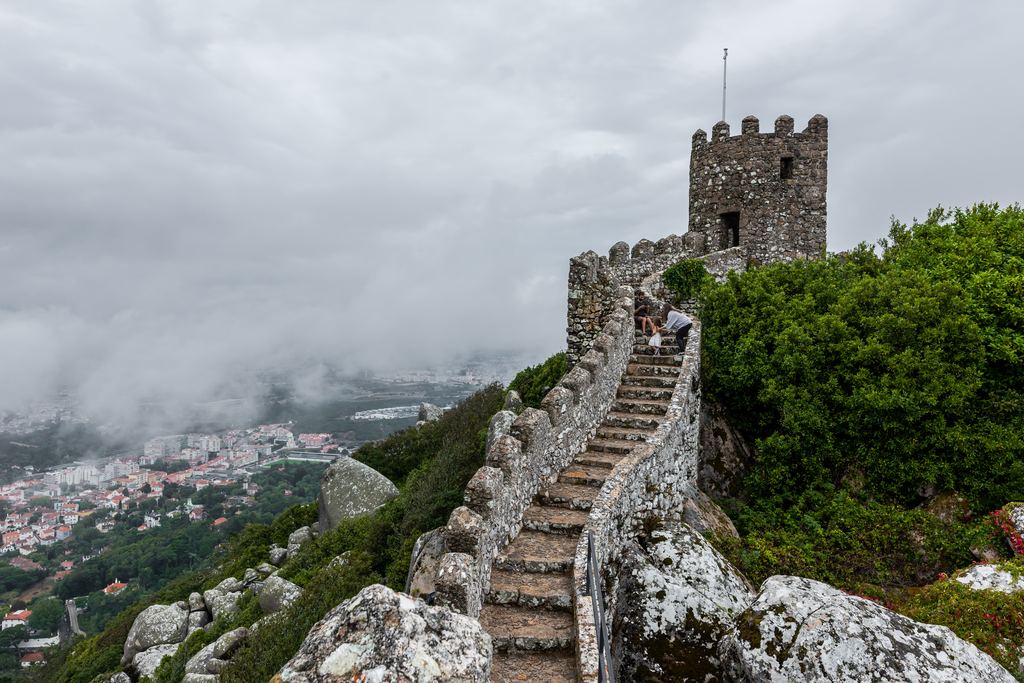
The visit weather cancels
A parapet walk is an outdoor activity in disguise
This is the wall of the Castelo dos Mouros above Sintra, on an ordinary day. The whole visit is that walkway. There is no interior to retreat into, no room to wait out a shower, and in cloud there is nothing to see from the top of it.
The same is true of every ruin, every rampart circuit and every castle whose selling point is the view. Sintra sits on the Atlantic side of a wooded ridge and makes its own weather: the microclimate that grew the park at Pena is the same one that hides the Moorish castle for hours at a time. If your day depends on a wall walk, it depends on the sky in a way an interior visit never does.
In the south, the month to avoid is the hot one
Northern European planning instincts are about rain, and they mislead badly around the Mediterranean. Granada in July averages a daily high of 36.4 degrees and one tenth of one rainy day. There is nothing to shelter from and very little shade in the Generalife. Seville is the same at 35.7. Florence, which people imagine as a comfortable city, records about twenty-four days above thirty degrees in July and again in August, which is most of both months.
What this does to a castle day is specific. It pushes everything into the first two hours after opening, it makes the queue rather than the visit the hard part, and it turns a courtyard with no trees into the least pleasant place in the city. Alhambra tickets for the Nasrid Palaces carry a fixed entry slot printed on the ticket, so an afternoon slot in August is not something you can quietly move.
Rain does decide the season in exactly three places in this catalogue, and they are all on the Atlantic. Porto records thirteen days of rain in November and twelve or thirteen through the winter. Cork reaches nearly seventeen in January. Inverness sits between thirteen and fourteen for five months of the year. Everywhere else the rain is an inconvenience rather than a plan.
| Destination | The month that decides | The number | What it means on the day |
|---|---|---|---|
| Granada | July | 36.4 C average high, 0.1 rain days | Go at opening or not at all. The Generalife has almost no shade |
| Seville | July and August | 35.7 and 35.6 C | The same problem, plus an Alcazar courtyard that holds heat |
| Florence | July and August | About 24 days above 30 C in each | Two whole months where the afternoon is the enemy |
| Scottish Highlands | May | 183 sunshine hours, the annual peak | The sunniest month is not July. Plan around this, not around summer |
| Cork | January | 16.7 days of rain of 1 mm or more | A ruin visit becomes a gamble. Interiors are unaffected |
| Porto | November | 13.0 rain days | The wettest month in this catalogue outside Ireland |
| Prague | January | 11.4 days when the high stays below zero | Ice days, not just frost nights. Outdoor circuits suffer |
| Bavarian Alps | January | 27 days with snow lying, at 719 m | Fussen sits higher still, so treat this as the minimum |
| Transylvania | January | 16 days of lying snow at Sibiu, 443 m | Sinaia and Peles are several hundred metres higher again |
| Beijing | January | 31 frost days and 0.5 rain days | The winter is bitter and bone dry, not wet |
| Venice | January | Highs of 7.7 C and 15 frost nights | Colder than most visitors expect from Italy |
| Vienna | December to February | Highs of 3.5 to 6.5 C | The palaces work all year. The gardens do not |
When to go, destination by destination
Built from thirty-year climate normals and from daylight, rather than from opinion. Highlighted months are the ones the numbers favour, not the busiest. Every row links to the destination.
| Month | 1 | 2 | 3 | 4 | 5 | 6 | 7 | 8 | 9 | 10 | 11 | 12 |
|---|---|---|---|---|---|---|---|---|---|---|---|---|
| WindsorHeathrow normals. June and July are the driest at about eight rain days; winter adds short days to the same rain | 1 | 2 | 3 | 4 | 5 | 6 | 7 | 8 | 9 | 10 | 11 | 12 |
| LondonThe interiors work all year, which is why London is the one place where a winter castle day is genuinely fine | 1 | 2 | 3 | 4 | 5 | 6 | 7 | 8 | 9 | 10 | 11 | 12 |
| Scottish HighlandsMay is the sunniest month of the year at Inverness, not July. December gives 6 h 38 of light and a 15:31 sunset | 1 | 2 | 3 | 4 | 5 | 6 | 7 | 8 | 9 | 10 | 11 | 12 |
| VersaillesThe gardens are the visit. May, June and September average under ten rain days and over 200 hours of sun | 1 | 2 | 3 | 4 | 5 | 6 | 7 | 8 | 9 | 10 | 11 | 12 |
| Loire ValleyJuly is the driest month at Tours, under seven rain days. December brings nine frost nights and winter hours | 1 | 2 | 3 | 4 | 5 | 6 | 7 | 8 | 9 | 10 | 11 | 12 |
| ParisDecember is the wettest month at Montsouris, at 11.4 rain days, and also the darkest | 1 | 2 | 3 | 4 | 5 | 6 | 7 | 8 | 9 | 10 | 11 | 12 |
| GranadaJuly and August average 36 C with essentially no rain. January is sunny but brings fifteen frost nights at 567 m | 1 | 2 | 3 | 4 | 5 | 6 | 7 | 8 | 9 | 10 | 11 | 12 |
| SevilleUnder one rain day in July, and 35.7 C. The summer risk here is heat, never weather | 1 | 2 | 3 | 4 | 5 | 6 | 7 | 8 | 9 | 10 | 11 | 12 |
| MadridEl Escorial sits higher and colder than the city. April to June and September to October are the honest window | 1 | 2 | 3 | 4 | 5 | 6 | 7 | 8 | 9 | 10 | 11 | 12 |
| SintraLisbon is a declared proxy. Sintra is on the Atlantic side of the ridge, systematically cooler and cloudier | 1 | 2 | 3 | 4 | 5 | 6 | 7 | 8 | 9 | 10 | 11 | 12 |
| LisbonJuly averages 0.4 rain days. The winter is mild but wet, at around ten rain days from November to January | 1 | 2 | 3 | 4 | 5 | 6 | 7 | 8 | 9 | 10 | 11 | 12 |
| PortoThe wettest place in this catalogue outside Ireland: thirteen rain days in November and twelve in December | 1 | 2 | 3 | 4 | 5 | 6 | 7 | 8 | 9 | 10 | 11 | 12 |
| VeniceJanuary highs of 7.7 C and fifteen frost nights, which is not the Italy people plan for | 1 | 2 | 3 | 4 | 5 | 6 | 7 | 8 | 9 | 10 | 11 | 12 |
| FlorenceAbout twenty-four days above 30 C in each of July and August. The winter is cold but the palaces are indoors | 1 | 2 | 3 | 4 | 5 | 6 | 7 | 8 | 9 | 10 | 11 | 12 |
| RomeTwenty-one days above 30 C in July and twenty-three in August. Castel Sant'Angelo keeps the same hours all year | 1 | 2 | 3 | 4 | 5 | 6 | 7 | 8 | 9 | 10 | 11 | 12 |
| FussenTwenty-seven days of lying snow in January at 719 m, and Fussen is higher. The bridge closes when it ices | 1 | 2 | 3 | 4 | 5 | 6 | 7 | 8 | 9 | 10 | 11 | 12 |
| CorkSixteen to seventeen rain days a month from November to January. June is the driest at ten | 1 | 2 | 3 | 4 | 5 | 6 | 7 | 8 | 9 | 10 | 11 | 12 |
| DublinNotably drier than Cork: 12.5 rain days in January against 16.7. The east coast is the sheltered side | 1 | 2 | 3 | 4 | 5 | 6 | 7 | 8 | 9 | 10 | 11 | 12 |
| BeijingJuly brings the monsoon, nine rain days and 31.8 C. January is bitter and dry, with 31 frost days | 1 | 2 | 3 | 4 | 5 | 6 | 7 | 8 | 9 | 10 | 11 | 12 |
| TransylvaniaSibiu is a declared proxy at 443 m. Bran sits higher and Sinaia higher again, so the snow figures are a floor | 1 | 2 | 3 | 4 | 5 | 6 | 7 | 8 | 9 | 10 | 11 | 12 |
| ViennaSchonbrunn and the Belvedere are interior visits and work all year. Their gardens are the seasonal part | 1 | 2 | 3 | 4 | 5 | 6 | 7 | 8 | 9 | 10 | 11 | 12 |
| PragueEleven days in January when the temperature never rises above zero. The castle complex is largely outdoors | 1 | 2 | 3 | 4 | 5 | 6 | 7 | 8 | 9 | 10 | 11 | 12 |
Normals 1991-2020 from national weather services and the WMO archive; daylight calculated. Sintra uses Lisbon, Fussen the Bavarian Alps, Transylvania uses Sibiu: all declared proxies.
What a thirty-year average is, and what it is not
Every number on this page is a climate normal for the period 1991 to 2020, the current standard block used by national weather services. Normals are not forecasts and they are not what happened last year. They are the average of thirty Julys, and any individual July can sit a long way off them.
They are also the reason this page will not need rewriting. The next standard block runs to 2050. Until then the figures here stay exactly as they are, which is the opposite of a page built on last season's opening hours.
One finding from assembling them is worth passing on, because it shows what happens when someone quotes the wrong block. The Spanish weather service still publishes 1981 to 2010 on its public pages. For Granada in July that older block gives 34.8 degrees; the current one gives 36.4. A degree and a half is the difference between a hot afternoon and an unwise one, and it is invisible unless the period is printed next to the number. Seville, by contrast, comes out identical in both blocks, which is a useful check that the Granada gap is real rather than a transcription error.
Where a monument has no weather station of its own we have said so rather than pretending. Sintra, Fussen and the Transylvanian castles all use a declared proxy, and in each case the proxy sits lower and milder than the castle. Treat those rows as the gentlest version of the conditions, not the likeliest.
Season questions with a number in the answer
Are castles open in winter?
Nearly all of the ones in this catalogue are, on a shorter timetable. Neuschwanstein runs nine to six from late March and ten to four from mid October. What closes independently of the building is the outdoor part: bridges, viewpoints, gardens and rampart walks come off the ticket when they ice up, while the interior stays open.
What is the worst month to visit a castle in southern Spain?
July, and it is not close. Granada averages a daily high of 36.4 C in July with 0.1 days of rain, Seville 35.7 C. There is no weather to avoid, only heat, and the Generalife and the Alcazar gardens have very little shade. If you must go in summer, take the first slot of the day.
How early does it get dark at a Scottish castle in winter?
In mid December the sun sets at 15:31 at Highland latitudes, after 6 hours and 38 minutes of daylight. In mid June the same place gets 17 hours 59. That factor of 2.7 is why a Highland ruin has a season and an Andalusian palace does not.
Is spring or autumn better?
It depends which half of Europe. In the north the two are not symmetrical, because May is the sunniest month of the year at Inverness while October is already dark. In the south they are close to interchangeable, with April, May, October and November all comfortable and the summer sitting between them as the part to plan around.
Does rain actually ruin a castle visit?
Only if the visit is outdoors, which is more often than people expect. A furnished interior is weatherproof. A parapet walk, a ruin or a hilltop viewpoint is not, and in cloud the view that justified the climb is simply not there. Check which kind of castle you have booked before you check the forecast.
Where do these numbers come from?
From national weather services and the World Meteorological Organization archive, for the standard period 1991 to 2020: the Met Office, Meteo-France, IPMA, AEMET, GeoSphere Austria and Met Eireann. Daylight is calculated from the standard solar position algorithm. Rain days use a threshold of one millimetre throughout, which is what makes the columns comparable between countries.

Data verified on. Climate normals 1991-2020 from national weather services and the WMO archive; station, period and threshold recorded for every figure. Daylight is calculated and does not expire.