
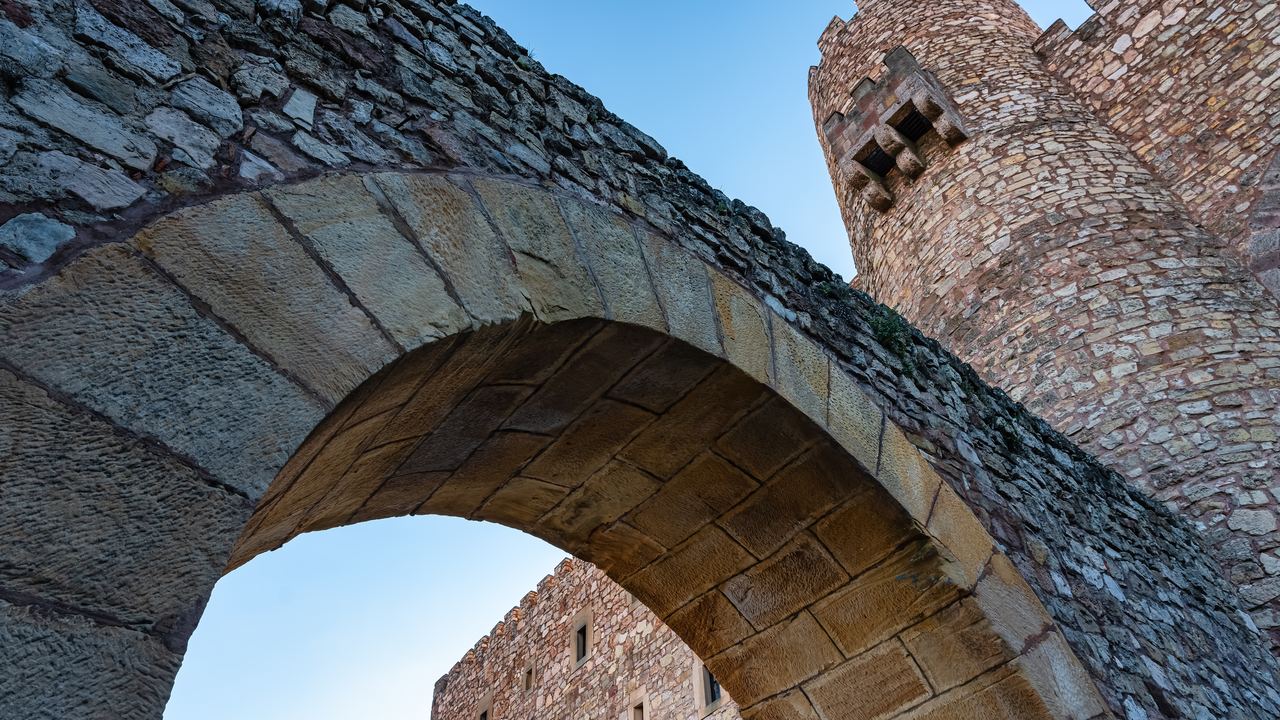
There are plenty of castle glossaries. Almost all of them are written for students, arranged alphabetically, and organised around the building rather than around the visit. That is a perfectly good thing to be, and it is not what a traveller needs at the moment of buying a ticket.
We went looking for one published by a heritage body and did not find it. Not English Heritage, not Historic Environment Scotland, not Cadw, not Historic Royal Palaces, not the National Trust. The nearest thing is a two-page activity sheet written for school parties visiting one castle in Herefordshire, which is a fine teaching aid, is not a reference work, and is not linked from anywhere a visitor would look.
So this one is arranged the other way round. First the words that appear on the ticket, which tell you what kind of building it is. Then the words that appear on the signs once you are inside.
The word on the ticket
This is the part no glossary does, and the part that is worth the most. Search engines are visibly bad at it: ask for the difference between the Spanish, German and French terms in one query and the results are language courses rather than anything about visiting buildings.
| Word | Language | What it means | What it predicts |
|---|---|---|---|
| Castle | English | Fortified residence of a lord | Stairs, thick walls, possibly no roof |
| Burg | German | Medieval fortified work | The real thing. Steep, and often a ruin |
| Schloss | German | Early modern lordly residence | Rooms and furniture. Neuschwanstein is one of these |
| Festung | German | Fortress, military | Walls, gun positions, a view |
| Bergfried | German | The tall tower of a German castle | A climb. It was a refuge and a lookout, not a home |
| Palas | German | The residential hall block of a Burg | Where the rooms are, if any survive |
| Chateau | French | Either. The adjective decides | Look for the words fort or Renaissance |
| Chateau fort | French | The fortified, medieval kind | Defences and a climb |
| Forteresse | French | Fortress | Military, public, garrisoned |
| Castillo | Spanish | Castle | Usually a real fortification |
| Alcazar | Spanish, from Arabic | Fortress, or a royal residence, fortified or not | Frequently the palace half is what you visit |
| Alcazaba | Spanish, from Arabic | Walled enclosure inside a town, sheltering a garrison | A citadel. Walls and views, few rooms |
| Palacio, palazzo, palais | Spanish, Italian, French | Palace, an official residence | Interiors, a fixed route, no cameras |
| Rocca | Italian | A fortified height or stronghold | A climb, and usually a ruin |
| Castelo, paco | Portuguese | Castle; palace | Sintra has both, twenty minutes apart |
| Hrad | Czech and Slovak | Castle, fortified | Karlstejn is one |
| Zamek | Czech | Chateau, residential | The Czech version of the Burg and Schloss split |
| Zamek | Polish | Castle, generally | Polish does not make the Czech distinction |
| Var, kastely | Hungarian | Castle; country house | The same split again, different words |
| Cetate, castel | Romanian | Fortress or citadel; castle | Rasnov is a cetate, Bran is a castel |
| Kale, hisar, saray | Turkish | Castle or fortress; fort; palace | Topkapi is a saray, not a kale |
| Qasr, qal'a | Arabic | Palace or fortified house; fort or citadel | The root behind alcazar and alcazaba |
| Kremlin, krepost | Russian | Fortified citadel of a town; fortress | A walled district rather than one building |
| Shiro, jo | Japanese | Castle | Timber and plaster. Ask whether the rebuild used either |
| Qila | Hindi and Urdu | Fort | Often a walled town rather than one building |
| Kasteel, slot | Dutch | Castle; castle or palace | Slot is closer to the German Schloss |
| Borg, slott, linna | Scandinavian and Finnish | Fortified place; palace or castle; castle | Borg is the fortified one |
| Caisteal, dun | Gaelic | Castle; fort, often prehistoric | A dun is usually far older than a castle |
The pattern running through that table is worth naming. A striking number of languages have two separate words where English has one, and in every case the split falls in the same place: fortified and medieval on one side, residential and early modern on the other. German does it with Burg and Schloss, Czech with hrad and zamek, Hungarian with var and kastely, Dutch with kasteel and slot.
English lost that distinction and French never had it, and between them those two languages run most of the world's castle tourism. Which is how a catalogue ends up filing Chambord and Caernarfon under the same heading.
Outside: the shape of the place
| Term | What it is |
|---|---|
| Motte | An artificial or shaped mound carrying a tower. The oldest element of the type |
| Bailey | The enclosed yard beside or below the motte, holding the working buildings |
| Ward | An enclosed courtyard inside the walls. Inner and outer wards are common |
| Curtain wall | The wall running between the towers. The main enclosing element |
| Enceinte | The complete circuit of the enclosing walls, taken as one thing |
| Chemise | A low wall wrapped around the base of a keep, like a coat |
| Zwinger | German. The ground trapped between an outer and an inner wall |
| Moat | The ditch around the site, wet or dry. Usually a status marker |
| Berm | The flat shelf between the wall base and the ditch |
| Counterscarp | The outer face of the ditch, on the attacker's side |
| Glacis | The smooth open slope beyond the works, leaving nowhere to hide |
| Batter, talus | The thickened outward slope at the base of a wall |
| Bastion | An angular projecting work, designed for cannon |
| Ravelin | A detached triangular outwork in front of the curtain |
| Star fort, trace italienne | The low angular artillery fortification that replaced tall walls after gunpowder |
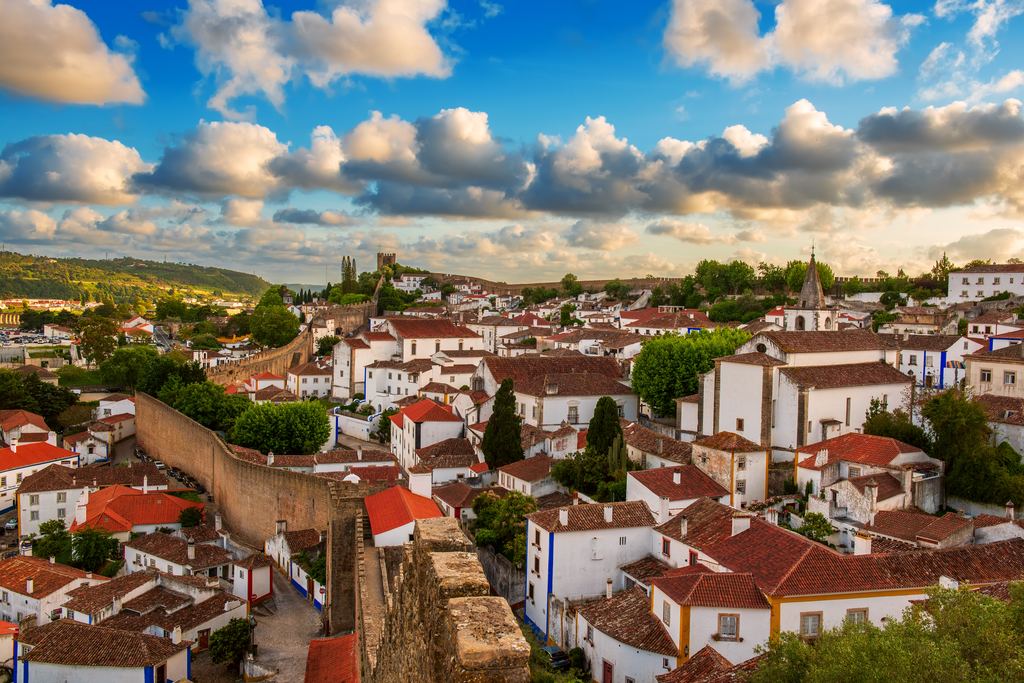
One word, seen from on top of it
The wall walk, or alure, or chemin de ronde
This is a wall walk: the walkway running behind the parapet along the top of a curtain wall. English has two words for it, alure being the older, and French has the one everybody borrows, chemin de ronde, which means the round the sentries made.
It is the most useful phrase in this glossary to recognise on a ticket page, because a monument whose selling point is a wall walk has no interior. That is the whole visit: an hour on top of a wall, weather permitting. The Moorish castle above Sintra is sold on exactly this and describes itself in exactly these words.
Getting in, and being stopped
| Term | What it is |
|---|---|
| Gatehouse | The fortified building containing the entrance, often the strongest part of the castle |
| Barbican | An outwork in front of the gate, forcing attackers into a confined approach |
| Chicane | A deliberate bend in the entrance passage, so nobody can charge straight through |
| Drawbridge | A bridge raised from inside, across the ditch |
| Portcullis | A heavy grille dropped in vertical grooves. Often two, with a trap between them |
| Murder hole | An opening in the ceiling of the gate passage, for dropping or pouring through |
| Machicolation | The same idea outdoors: a parapet carried out on corbels with gaps in its floor |
| Corbel | The projecting stone bracket that carries a machicolation or a floor beam |
| Postern | A small secondary gate, often hidden. The way out rather than the way in |
| Wicket | A person-sized door set into a larger gate |
Going up
| Term | What it is |
|---|---|
| Keep | The strongest tower, and the lord's residence of last resort |
| Donjon | French for the keep. It does not mean dungeon, although our word came from it |
| Torre del homenaje, mastio | Spanish and Italian for the keep |
| Shell keep | A ring of stone wall replacing the timber palisade on top of a motte |
| Newel stair | A spiral stair turning around a central post, the newel. The wedge-shaped treads are why they are hard |
| Mural stair | A stair built inside the thickness of a wall |
| Turret | A small tower, usually corbelled out rather than rising from the ground |
| Drum tower | A round tower. Curved walls deflect missiles and have no corner to undermine |
| Parapet | The low protective wall at the outer edge of a wall walk |
| Battlement | The notched parapet as a whole, solid parts and gaps together |
| Merlon | The solid upright block of a battlement |
| Crenel | The gap between two merlons. This is the part people mean when they say battlement |
| Embrasure | An opening splayed wider on the inside, so a defender has room to aim |
| Crenellate | To build battlements. In medieval England this needed a royal licence, for reasons of status |
| Hoarding, brattice | A temporary timber gallery hung out from the wall top in wartime |
Shooting from it, and living in it
| Term | What it is |
|---|---|
| Arrowslit, loop, loophole | A narrow vertical opening to shoot through |
| Cross loop | A loop with a horizontal bar, making a cross. Widely said to be for crossbows, with no clear source |
| Oillet | The round hole at the end of a loop, widening the field of view |
| Gun loop, gunport | A later, keyhole-shaped opening for firearms |
| Meurtriere, archere, arbaletriere | French for a loop generally, for a bow loop, and for a crossbow loop |
| Great hall | The main communal room: eating, business, and sleeping for the household |
| Solar | The lord's private chamber, usually above one end of the hall |
| Undercroft | The vaulted storage space beneath the hall |
| Buttery, pantry | Store rooms off the hall, for drink and for bread |
| Garderobe | A latrine, and also a wardrobe. Properly a small room for keeping valuable clothing |
| Oubliette | A pit reached only from above. Far rarer than the tours suggest |
| Ashlar | Squared, dressed stone laid in courses. Expensive, and usually only a facing |
| Rubble | Irregular stone, the usual core behind the ashlar |
| Lime render | The plaster coat that waterproofed and whitened the walls. Almost none survives |
Two definitions worth correcting
The only glossary we found from a heritage body is a two-page pack written for school groups at Goodrich Castle. It is a teaching aid rather than a reference, and it would be unfair to hold it to reference standards, but two of its entries are worth flagging because both are repeated widely elsewhere.
It defines battlements as the rectangular gaps in a defensive wall. Those gaps are the crenels, or embrasures. Battlements are the whole arrangement, the solid merlons and the gaps between them. If the word meant only the gaps, then crenellating a wall would mean cutting holes in it, and a licence to crenellate would be permission to do damage.
And it glosses capon as a cockerel. A capon is a castrated cockerel, which is the entire point of the word: castration was how a bird was fattened for the table. In a glossary about castle kitchens that is exactly the interesting part.
We flag them not to score a point but because they are the closest thing to an official definition available online, and both errors have onward lives.
False friends and words that shift
A handful of terms cause more trouble than all the rest combined, usually because the word survived into modern English with a different job.
Donjon is not dungeon. The French word means the keep: the great tower, the most prestigious building on the site, and the lord's own residence. English borrowed it and, over a few centuries, attached it to the least prestigious space imaginable. If a French sign points to the donjon, it is pointing at the tower, and you are about to climb it.
Castle does not mean old. Neuschwanstein was begun in 1868 and Eilean Donan as it stands was finished in 1932. Neither the word nor the silhouette is a guide to the date.
Palace is about office, not size. A palace is an official residence, which is why Buckingham Palace and Windsor Castle belong to the same family and keep different words.
Fort, in India, is often a city. The hill forts of Rajasthan enclose urban centres, palaces, markets and temples inside defensive walls that run, in places, for twenty kilometres.
Reconstructed does not mean fake, and original does not mean intact. In the Japanese tradition, where the material is timber, the meaningful question about a rebuilt castle is whether it was rebuilt in wood or in concrete. That is the local form of the question the rest of this site asks as ruin, reconstruction or furnished palace.
The words people look up most
What is the difference between Burg and Schloss?
A Burg is a medieval fortified building; a Schloss is an early modern lordly residence without pronounced defences. The same split exists in Czech as hrad and zamek, in Hungarian as var and kastely, and in Dutch as kasteel and slot. English and French both lost it, which is why English catalogues put fortresses and palaces under one heading.
Does donjon mean dungeon?
No. Donjon is French for the keep: the great tower, the lord's own residence, and the most prestigious building on the site. English borrowed the word and gave it to the prison. A French sign pointing to the donjon is pointing at a climb.
What is the difference between a merlon and a crenel?
The merlon is the solid upright block, the crenel is the gap between two of them, and the two together are the battlement. Most people use battlement to mean the gap, which is also the error in the only institutional glossary we could find.
What is a bailey?
The enclosed yard beside or below the motte, where the stables, kitchens, workshops and stores stood. Motte and bailey is the earliest castle form: a mound with a tower on it, and a defended yard next to it.
What does a parapet walk mean on a ticket page?
That the visit is the top of the wall and there is no interior. It is also called a wall walk, an alure, or in French a chemin de ronde. Recognising the phrase is the fastest way to tell a rampart visit from a room visit before you pay.
Which glossary should I trust?
For terminology, the Getty Art and Architecture Thesaurus and the monument type thesaurus published by Historic England, both free to consult. For French, the architecture thesaurus of the French Ministry of Culture, which is openly licensed. No heritage body we checked publishes a visitor-facing glossary as a web page, which is why this one exists.
Data verified on. Built on the Getty Art and Architecture Thesaurus, the Historic England monument type thesaurus, the French Ministry of Culture architecture thesaurus, the Spanish Royal Academy and UNESCO.