Castles · Tour
Madrid Old Town: the Square That Changed Its Name Five Times
Ratings collected by Viator and Tripadvisor
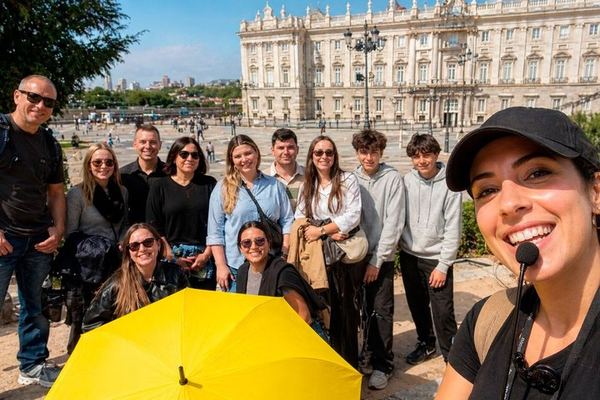
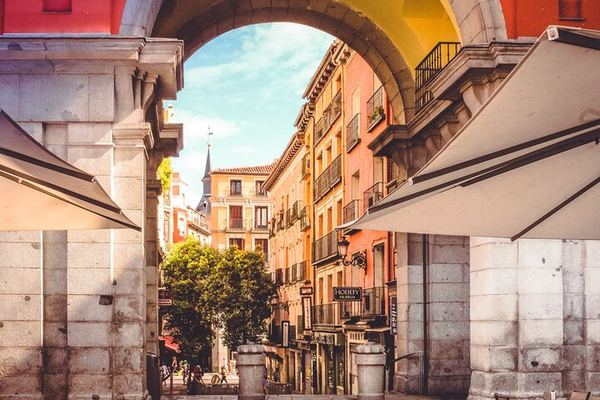
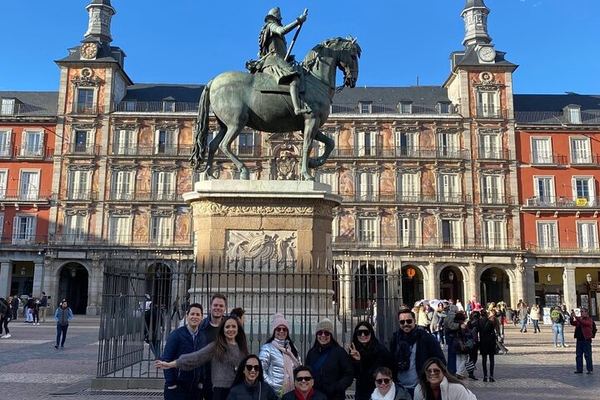
MadridThe walk begins outside the Fun and Tickets office on Calle Mayor and works its way through the old town to the Royal Palace, where the group goes in with official guides and no queue. What makes the approach worth doing on foot is that this part of Madrid records its politics in its street signs. The Plaza Mayor has been the Plaza del Arrabal, the Plaza de la Constitución, the Plaza Real, the Plaza de la República and finally the Plaza Mayor. Every rename followed a change of regime, and it took the end of the Civil War to settle it. Standing in the square with that list in hand is a short course in modern Spanish history. The route also passes the Mercado de San Miguel, open for more than a century and now more than twenty stands of Iberian ham, Galician shellfish, rice and cheese; the Calle del Codo; and the Plaza de la Villa, where three of the city's original streets meet and the Casa y Torre de los Lujanes has stood since the 15th century. The Royal Palace is where the visit proper starts: the largest inhabited palace in Europe, and the official residence of a king who lives at the Zarzuela instead.
What's included
- Official Guide - Spanish Group or English Group
- Royal Palace Skip the line ticket and Guided tour inside
- Guided Tour from Calle Coloreros, 2
- Early Entrance and Offcial guided Tour of the Royal Palace
Show 1 moreShow less
- Visit with Radio Guide and gift headphones.
Itinerary
The map could not be loaded. Please try again in a moment.
C. de los Coloreros, 2, Madrid
Everyone is met 10 minutes before the start at the door of the main Fun and Tickets office.
Welcome to our meeting point located at Calle Mayor 43
The meeting point is at Calle Mayor 43. The visit to the Royal Palace starts from here.
Plaza Mayor
The square has changed its name repeatedly, and each name belongs to a regime: Plaza del Arrabal, Plaza de la Constitución, Plaza Real, Plaza de la República, and now Plaza Mayor. Arrabal was the original name, and until the end of the 15th century this was the busiest marketplace in the city. After the Constitution of 1812 every major square in Spain became a Plaza de la Constitución, a name this one carried again from 1820 to 1823, 1833 to 1835, 1840 to 1843 and 1876 to 1922. With the Bourbon restoration of 1814 it was the Plaza Real. In 1873 it became the Plaza de la República. The present name dates from the end of the Spanish Civil War.
Mercado San Miguel
The Mercado de San Miguel opened more than a hundred years ago as a wholesale food market and is now one of the best known food halls anywhere. What it sells is Spain by region. Iberian ham, fish and shellfish brought up from Galicia every day, Mediterranean rice, and cheese from Castile, Asturias and the Basque Country. More than twenty stands, all of them working to the same standard of tapas and bar food.
Calle De Codo
This short street links two of the finest small squares in Madrid, Conde de Miranda and Villa, and the whole stretch is protected. On the corner of the Plaza de la Villa stands the 15th-century Torre de los Lujanes. Along the same street are the Real Sociedad Económica Matritense de Amigos del País, the old municipal newspaper library, and the Church of Corpus Christi with the Convent of Las Carboneras, whose nuns keep an image of the Immaculate Conception found in a charcoal kiln and credited with miracles.
Plaza de la Villa
One of the main medieval centres of Madrid, with three streets from the original city plan running off it: Codo, Cordón and Madrid. Three buildings of different centuries face onto it. The oldest is the Casa y Torre de los Lujanes, 15th century and Gothic-Mudéjar, on the east side, now the seat of the Academy of Moral and Political Sciences.
Royal Palace of Madrid
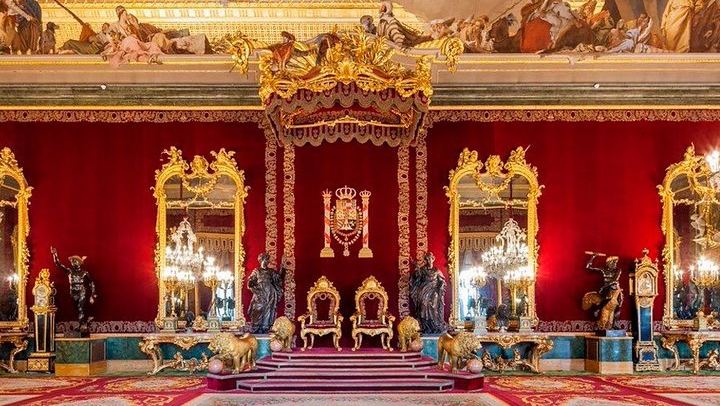
The Royal Palace of Madrid is the official residence of the King of Spain, though the present monarchs live at the Zarzuela Palace and this building is used for state ceremonies and formal occasions. This is where the visit proper begins. Juvarra's original design was never built, but what replaced it is the largest inhabited palace in Europe: inhabited in the official sense, since the royal family keeps its residence here without living in it. Work ran until 1764, when Carlos III became the first king to occupy it. The building covers 135,000 square metres and 3,418 rooms, with 870 windows, 240 balconies and 44 staircases.
Royal Alcazar of Madrid, Madrid
The tour ends when the visit to the Royal Palace is over.
Not included
- Gratuities
Good to know
- Infants and small children can ride in a pram or stroller
- Public transportation options are available nearby
- Suitable for all physical fitness levels
- Although the entrance to the Royal Palace is always reserved for our clients, sometimes the access control may be blocked due to the capacity and security controls, being the entrance delayed a few minutes for reasons beyond the control of this operator.
Show 5 moreShow less
- To speed up entry, rucksacks and large bags are not permitted.
- Check-in at our main office is mandatory. Please do not go directly to the Royal Palace.
- Up to 15 travelers per booking.
- Mobile or paper ticket accepted
- Guiding available in: en, es.
Reviews
Loading reviews…