Castles · Tour
Ninety Minutes on the Medici, with Every Statue in the Signoria Named
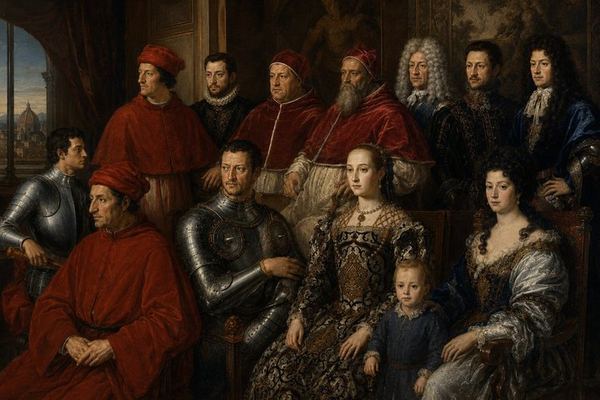
The Medici between art and power, walked in an hour and a half. Banking, trade and influence inside the church took this family from money to government, and the guide follows that in the order it happened. What is left of it is the buildings and the art, almost all of it paid for by the Medici, and a professional guide takes the group through them in a small group and a tight ninety minutes.
What's included
- Live commentary
- audio guides systems
- Art guide
- Walking tour along the path of the Medici Residences
Itinerary
The map could not be loaded. Please try again in a moment.
Via Camillo Cavour, 21R, Firenze
Note that 21 is a red number.
Palazzo Medici Riccardi
Michelozzo built the Palazzo Medici Riccardi for Cosimo il Vecchio after 1444, as his town house on the via Larga, now via Cavour. Beyond the exterior, what survives from that period is the main courtyard with its classical reliefs in the tondi, Michelozzo's small chapel on the first floor, and the frescoes Cosimo commissioned from Benozzo Gozzoli to decorate it.
Costo extra
Basilica di San Lorenzo
The church was tied to the Medici from the moment they commissioned Brunelleschi to rebuild it in 1425, with their own money. Every principal member of the family from Cosimo il Vecchio to Cosimo III is buried here.
Costo extra
Cappelle Medicee
The Cappella dei Principi is the mausoleum of the Medici grand dukes, and it does not undersell them. Ferdinando I ordered it built, and intended it faced in costly jasper. A back passage connects it to the New Sacristy, which Michelangelo built to balance Brunelleschi's Old Sacristy. Inside are the Medici tombs, with the statues Michelangelo carved for them.
Costo extra
Cupola Del Brunelleschi
The dome of Santa Maria del Fiore was built by Brunelleschi, who worked for the Medici.
Piazza della Signoria
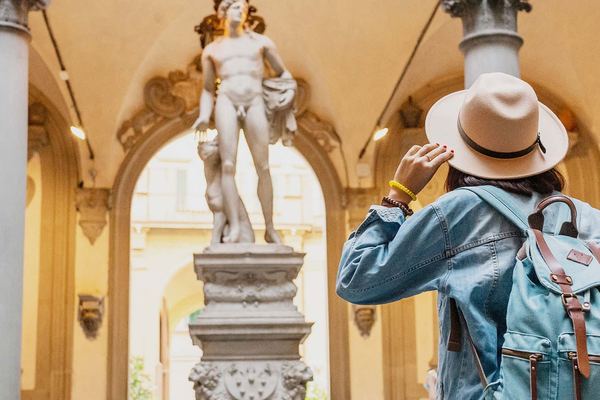
The 14th-century Palazzo Vecchio still dominates the square, with its crenellated tower. Around it stand the Loggia della Signoria, the Uffizi, the Palace of the Tribunale della Mercanzia and the Palazzo Uguccioni, whose facade is attributed to Raphael, who died thirty years before it was built. The statues around the square include: The copy of Michelangelo's David. The original is in the Galleria dell'Accademia. The equestrian monument to Cosimo I de' Medici, by Giambologna. The Fountain of Neptune, by Bartolomeo Ammannati. Il Marzocco, the lion, with a copy of the Florentine lily, originally by Donatello. Judith and Holofernes, by Donatello. Hercules and Cacus, by Bandinelli. The Rape of the Sabine Women, in the Loggia dei Lanzi, by Giambologna. Perseus with the Head of Medusa, in the Loggia dei Lanzi.
Uffizi
One of the most important museums in Italy and the most visited, and one of the largest and best known anywhere, holding a collection that has no price, particularly of the Italian Renaissance.
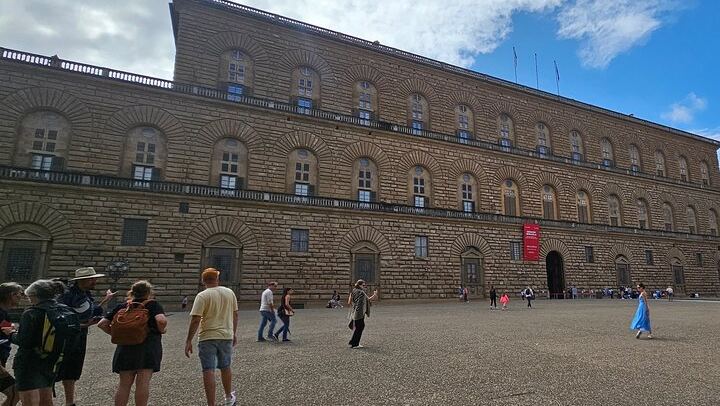
Palazzo Pitti
The Medici bought the palace in 1549 and it became the principal residence of the ruling families of the Grand Duchy of Tuscany. Successive generations turned it into a treasure house of paintings, plate, jewellery and everything else they could acquire.
Costo extra
Oltrarno, Florence
Palazzo Pitti.
Not included
- Entrance and Tickets
- Pick up from hotel
Good to know
- Wheelchair accessible
- Infants and small children can ride in a pram or stroller
- Public transportation options are available nearby
- Transportation options are wheelchair accessible
Show 6 moreShow less
- All areas and surfaces are wheelchair accessible
- Suitable for all physical fitness levels
- Children must be accompanied by an adult
- Up to 15 travelers per booking.
- Mobile or paper ticket accepted
- Guiding available in: en.
Reviews
Loading reviews…