Castles · Tour
The Library That Announced the Medici Were No Longer Merchants
Ratings collected by Viator and Tripadvisor
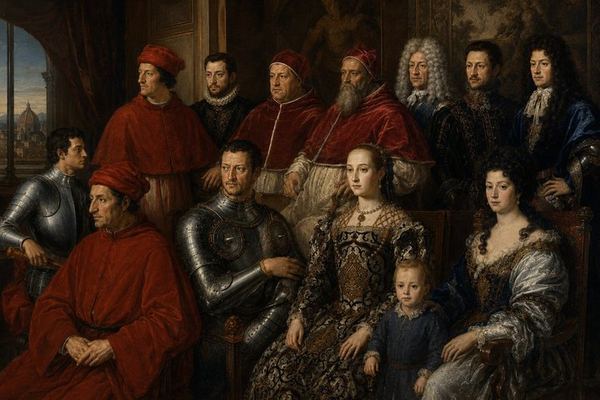
FlorenceThe Medici story walked through the streets and palaces where it happened, in a small group. The subject is the rise of the family and what political power and art did for each other in Florence. How a banking family held the city for over three centuries, and what it meant that they were the ones paying Michelangelo, Botticelli and Raphael. The route includes the Laurentian Library, which is the clearest single statement the family ever made: commissioned by a Medici pope, designed by Michelangelo, and built to establish that the Medici were no longer merchants but part of the intellectual and ecclesiastical order.
What's included
- Small group
- Licensed tour guide
- whisper system
Itinerary
The map could not be loaded. Please try again in a moment.
Piazza di San Giovanni, 19R, Firenze
The meeting point is next to Cafè Scudieri, 50 metres from the facade of the Duomo. Look for the guide with a small red flag.
Basilica di San Lorenzo
The Basilica di San Lorenzo is one of the largest churches in Florence, at the centre of the main market district, and the burial place of every principal Medici from Cosimo il Vecchio to Cosimo III.
Costo extra
Biblioteca Medicea Laurenziana
The Laurentian Library was built under the patronage of the Medici pope Clement VII, to establish that the family were no longer merchants but part of the intellectual and ecclesiastical world. It holds the manuscripts and books of the private Medici library. The architecture is by Michelangelo, and it is one of the defining works of Mannerism.
Costo extra
Cappelle Medicee
The Medici Chapels were built between the 16th and 17th centuries as extensions to Brunelleschi's 15th-century church, to commemorate the family who had paid for the church and who by then were Grand Dukes of Tuscany. The Sagrestia Nuova, the New Sacristy, was designed by Michelangelo.
Costo extra
Palazzo Medici Riccardi
The Palazzo Medici Riccardi was designed for Cosimo de' Medici, head of the family bank, and built between 1444 and 1484.
Costo extra
Cathedral of Santa Maria del Fiore
Florence Cathedral, formally the Cattedrale di Santa Maria del Fiore, was begun in 1296 in the Gothic style to a design by Arnolfo di Cambio. The complex in Piazza del Duomo includes the Baptistery and Giotto's Campanile, and all three are part of the UNESCO World Heritage Site covering the historic centre.
Costo extra
Battistero Di San Giovanni
The Florence Baptistery, the Baptistery of Saint John, stands in the Piazza del Duomo and the Piazza San Giovanni, opposite the cathedral and the Campanile. It is one of the oldest buildings in the city, built between 1059 and 1128 in the Florentine Romanesque style.
Costo extra
Cupola Del Brunelleschi
The dome is still one of the open questions of art and architecture. It was the largest in the world when built, and it remains the largest brick dome ever constructed.
Costo extra
Campanile di Giotto
Giotto's Campanile stands beside the Basilica of Santa Maria del Fiore and the Baptistery. It is one of the great pieces of Florentine Gothic, designed by Giotto, heavily carved and faced in polychrome marble.
Costo extra
Cathedral of Santa Maria del Fiore
The Cathedral of Florence, Santa Maria del Fiore, is an enormous Gothic building with a facade worked in white, green and pink marble.
Costo extra
Palazzo Vecchio
The Palazzo Vecchio, the Old Palace, is the town hall and the most imposing in Tuscany. It looks over the square, with the copy of Michelangelo's David outside and the statues of the Loggia dei Lanzi alongside. It holds museums and cultural spaces and is still one of the most important public buildings in Italy.
Costo extra
Piazza della Signoria
Piazza della Signoria is the L-shaped square in front of the Palazzo Vecchio, where Florentines meet and where everyone else ends up, between the Palazzo Vecchio, the Duomo and the entrance to the Uffizi.
Costo extra
Ponte Vecchio
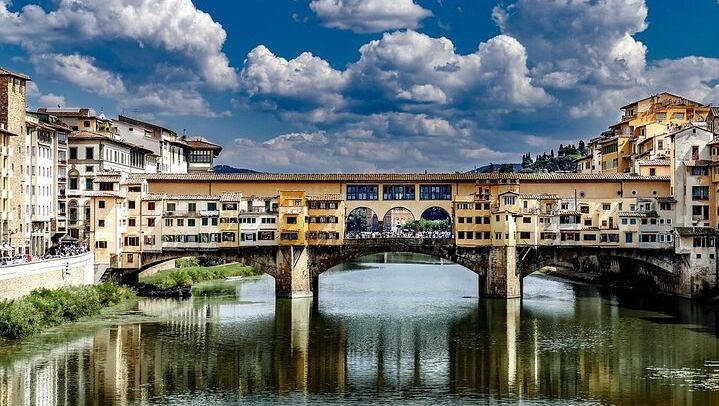
The Ponte Vecchio is the oldest bridge over the Arno, medieval, and known for the shops built along it, which was once normal practice. Butchers, tanners and farmers held them first. The tenants now are jewellers and art dealers.
Palazzo Pitti
The Medici bought the Pitti Palace in 1549, and it became the principal residence of the ruling families of the Grand Duchy of Tuscany. Successive generations filled it with paintings, plate, jewellery and everything else money could buy.
Costo extra
Le Gallerie Degli Uffizi
The Uffizi is the most visited museum in Italy and holds one of the largest and best known collections of Renaissance painting in the world. Michelangelo, Leonardo da Vinci, Raphael, Botticelli and the rest are all here. The guided visit runs through more than 80 rooms of work spanning the 12th to the 16th century. There is no better collection of Renaissance painting anywhere.
Costo extra
Ponte Vecchio, Firenze
The end point is indicative and can vary slightly within the area shown.
Not included
- Tips and gratuities (optional)
Good to know
- Public transportation options are available nearby
- Infants and small children can ride in a pram or stroller
- All areas and surfaces are wheelchair accessible
- Transportation options are wheelchair accessible
Show 5 moreShow less
- Wheelchair accessible
- Suitable for all physical fitness levels
- Up to 15 travelers per booking.
- Mobile or paper ticket accepted
- Guiding available in: en, it.
Reviews
Loading reviews…