Castles · Tour
Belém in the Morning, the Old City After, on Foot from the Tower to São Pedro
One day, on foot, from the Belém Tower to the São Pedro de Alcântara viewpoint, which is about as much of Lisbon as anyone can cover between breakfast and evening. The morning belongs to Belém and the Age of Discovery: the tower, the monastery, the monument on the waterfront, and the guide filling in what the stones were built to say. Lunch is a 90-minute break, with the Time Out Market as the recommendation and the meal at your own expense, and then the historic centre starts. The afternoon runs through the Arch of Rua Augusta, the Santa Justa lift, the Carmo church that lost its ceiling in 1755, Alfama, the Cathedral and the São Pedro de Alcântara viewpoint, where the walk ends. World heritage monuments in the morning, narrow streets in the afternoon, and a good deal of climbing in between: Lisbon does not lie flat, and this route does not pretend otherwise.
What's included
- The Original Pastel de Belém.
- Group excursion with a maximum of 20 adults.
- Informative, friendly and professional guide
- Entrance to iconic monuments.
Show 1 moreShow less
- Plenty of stories and local suggestions to enjoy Lisbon.
Itinerary
The map could not be loaded. Please try again in a moment.
Av. Brasília, Lisboa
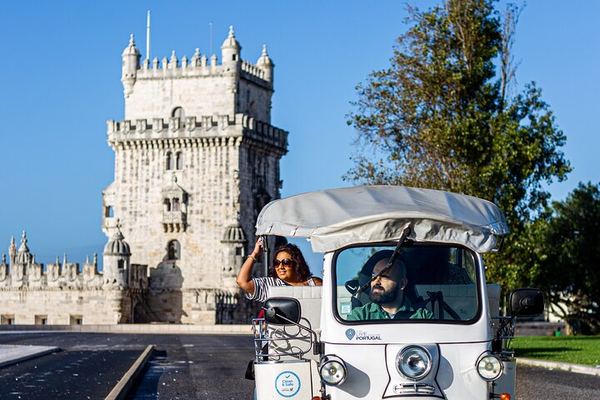
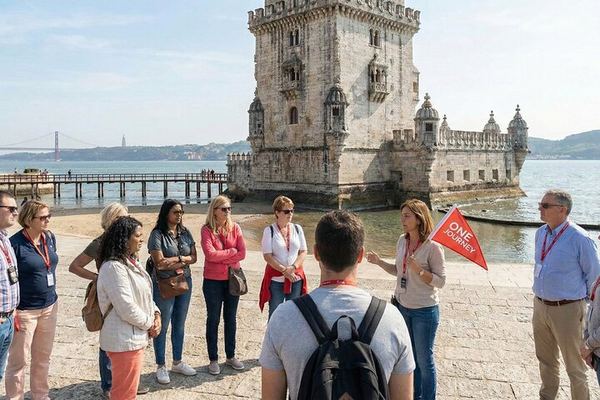
The guide waits next to the small 3D model, right in front of the main entrance of the Torre de Belém.
Torre de Belem
The Torre de Belém, one of the monuments Lisbon is recognised by.
Belem
A walk along the Tagus with the history of the Portuguese Discoveries.
Padrao Dos Descobrimentos
The Monument to the Discoveries is a caravel the size of a building, with Henry the Navigator at the prow leading the Portuguese expansion by sea. The tour does not go inside.
Costo extra
Rosa dos Ventos
The other landmark in Belém is the Wind Rose square, with a map 14 metres across and a compass rose 50 metres wide laid into the pavement.
Jardim da Praca do Imperio
A garden built for the Portuguese World Exhibition of 1940, which marked 800 years of Portuguese independence and 300 since its restoration, designed by the architect Cottineli Telmo. The Luminous Fountain at its centre dates from the same moment. The arrangement follows the logic of Greek and Roman gardens, and it holds together because of that. There is a sundial as well, and all of it is built in mosaic work. The two lakes at the southern end carry sculptural groups of mythical horses with the tails of sea creatures.
Jeronimos Monastery
In 1496 King Manuel I asked the Holy See for permission to build a large monastery on the bank of the Tagus. Diogo de Boitaca drew it, construction began on 6 January 1501, and the work finished at the end of the 16th century. The style is Manueline and the occasion was the return of Vasco da Gama from the Indies. The site, the Ermida do Restelo, was already where sailors put in before a voyage. The trade with Africa and the Orient paid for it, which is why it is the most emblematic Manueline building in the country, the style also called Portuguese Gothic. The cloisters are the part nobody forgets.
At the beginning of the 19th century
At the start of the 19th century there was a sugar cane refinery next to the Jerónimos Monastery, with a small shop attached. After the Liberal Revolution of 1820, every convent in Portugal was closed in 1834 and the clergy and workers were turned out. To survive, somebody from the monastery started selling sweet pastries in that shop, and they were called Pastéis de Belém almost at once. Production began properly in 1837, in buildings next to the refinery, to the old secret recipe that had come out of the convent. It is still made by hand by the master confectioners in the Oficina do Segredo, and the recipe has not changed.
Time Out Market Lisboa
This is where the lunch break is recommended. A former food market, once known for its flowers and the quality of its fish, now rebuilt with dozens of places to eat for every taste and age. The break is 90 minutes, the meal is not in the ticket price, and you can spend it here or anywhere else you like.
Costo extra
Praca do Comercio
One of the largest squares in Europe, some 36,000 square metres, with 79 arches around it. Before the earthquake of 1755 this was the royal palace, the official residence of the Portuguese kings for about 250 years. It was from here that the Marquis of Pombal planned the new city, with this square as its statement. The buildings on the Terreiro do Paço now hold ministries, government departments, and mostly hotels and restaurants.
Miradouro de Santa Luzia
The most romantic viewpoint in Lisbon, which is a strong claim in a city with this many. A window under creepers, looking over the roofs of Alfama, the churches of the oldest quarter, and the boats crossing the Tagus. The two tile panels from the Fábrica Viúva de Lamego on the side wall of the Igreja de São Brás, and the Igreja de Santa Luzia built on the Cerca Velha, are postcards inside the postcard.
Lisbon's Cathedral
Lisbon Cathedral, also called the Basilica of Santa Maria Maior, is the oldest church in the city, built in the second half of the 12th century after King Afonso Henriques took Lisbon back from the Moors. It stands on a mosque, and under that, according to the excavations, a Christian temple of the Visigoths. The first architect was Master Roberto, a Frenchman who also worked on the Sé of Coimbra and the Monastery of Santa Cruz. Dedicated to Our Lady, the Sé has been altered repeatedly over the centuries, particularly after 1755. Romanesque, Baroque and Neoclassical detail all sit on the same building. The tour does not go inside.
Costo extra
This church stands on the spot where St
This church stands where St Anthony was born, before he left to preach and eventually died in Padua. The present building went up after the 1755 earthquake, on a site that had held a chapel since the 15th century. Worth looking for: the image of the saint, which the earthquake spared, the crypt over his birthplace, and the canvas showing St Anthony with the most authentic features on record. Pope John Paul II visited in 1982.
Igreja de Nossa Senhora da Conceicao Velha
The facade of the Church of Nossa Senhora da Conceição Velha is, with the Jerónimos Monastery and the Belém Tower, one of the best Manueline structures to come through the earthquake. Angels, flowers and religious symbols run into each other in a composition that has no obvious parallel. The building assembles parts of several churches, the result of the rebuilding after 1755, when most of the city came down.
Alfama
This quarter was once among the most cosmopolitan in Lisbon. Between the castle and the river, Alfama goes back to the time of the discoveries. Its houses came through the 1755 earthquake and the facades are the originals. The atmosphere is the point, along with the small shops and taverns, reached through a steep web of streets and alleys.
Casa dos Bicos-Museu de Lisboa
The Casa dos Bicos was built in 1523 for D. Brás de Albuquerque. The facade is faced with diamond-cut stone, the bicos, after a trip the owner made to Bologna where he saw the Diamond Palace. The main front originally faced north, and what is now the main facade was the lesser one. The top two floors came down in the 1755 earthquake and were not restored until 1983. The building now houses the José Saramago Foundation.
Costo extra
Arco do Triunfo
The triumphal arch of the city is the doorway into the Baixa Pombalina, drawn after the 1755 earthquake and not finished until 1873. At the top, an allegorical group of Glory crowning Genius and Valour, by the French sculptor Anatole Calmels. Below it, left to right, Viriato, Vasco da Gama, the Marquês de Pombal and Nuno Álvares Pereira, these by the Portuguese sculptor Vítor Bastos, flanked by figures of the Tagus and the Douro. The whole thing faces the river the Portuguese sailed from, which is the argument the arch was built to make.
Rua Augusta
Rua Augusta is the busiest street in central Lisbon. It starts at the triumphal arch, runs between Praça do Comércio and Praça do Rossio, and is paved in Portuguese calçada. The commerce along it is dense, shop after shop, many of them international brands. It has been closed to traffic since the late 1980s, and street performers, craftsmen and vendors have had it since.
Praca Dom Pedro IV
Praça Dom Pedro IV, the Rossio, was the centre of Lisbon through the Middle Ages: the fairs, the festivals, and the public bonfires. During the Second World War this was one of the largest espionage centres on the planet, and a great many refugees ended up waiting here for visas. The D. Maria National Theatre stands at the north end, the statue of D. Pedro IV in the middle, and terraces everywhere. Rossio holds more history per square metre than anywhere else in the city.
Convento do Carmo
The Carmo church was built to pay a promise Dom Nuno Álvares Pereira made to Our Lady of Carmo. With the Spanish forces defeated, work began in 1389 on what became the largest Gothic monument in the city, and it mattered quickly, to Lisbon and to the country's idea of itself. The entire ceiling of it came down on 1 November 1755, when the earthquake flattened the city. The convent stayed standing, but the fire that followed took most of the art. Queen Maria I wanted it rebuilt. The money ran out, the work stopped, and the church has stood open to the sky ever since, as a reminder of that All Saints' Day. The tour does not go inside.
Costo extra
Igreja de Sao Roque
The story starts in 1506, when King Manuel I asked Venice for a relic of São Roque, a saint credited with miracles against the plague. A chapel went up shortly after outside the Fernandina wall, beside the cemetery of the plague dead. The church standing today came through the earthquake almost untouched and was completed by the Italian architect Filipo Terzi. The mannerist facade is plain, which is the joke, because inside is one of the most valuable chapels anywhere. Each chapel in São Roque is a work in its own right, but one deserves hours: the chapel of St John the Baptist, a masterpiece of Italian art with no equal in Italy either. King João V commissioned it, Pope Benedict XIV consecrated it in Rome, and it is a national treasure of Italian baroque.
Miradouro Sao Pedro de Alcantara
Lisbon has no shortage of viewpoints, and this is the one to stop at if you are on that hill. Nothing about it now suggests that for a couple of centuries this was considered a cursed spot in the city. Only at the end of the 19th century did the miradouro become a public space the bourgeoisie wanted to be seen in. The tile panel by Fred Kradolfer names what you are looking at: the Graça Church, São Jorge Castle, the Cathedral.
R. de São Pedro de Alcântara 85, Lisboa
The walk ends near the São Pedro de Alcântara viewpoint.
Not included
- Private transportation
- The travellers will have a 90 minute period to enjoy lunch.
- In some monuments, the guide is not allowed to provide info inside.
Good to know
- Infants and small children can ride in a pram or stroller
- Service animals allowed
- Public transportation options are available nearby
- Not recommended for travelers with spinal injuries
Show 4 moreShow less
- Travelers should have at least a moderate level of physical fitness
- Up to 15 travelers per booking.
- Mobile or paper ticket accepted
- Guiding available in: es.
Reviews
Loading reviews…