Castles · Tour
Braga and Guimarães from Porto, and the Water-Powered Funicular of 1882
Ratings collected by Viator and Tripadvisor
PortoThe Minho is the old province in the north of Portugal, green, cut through by rivers, with a long coastline and beaches at the end of it. This is the full day that crosses it, and it takes in the two cities that matter: Braga and Guimarães, both of them older than the country. Braga has the first cathedral built in Portugal, consecrated in 1089, decades before there was a Portugal to build it in. It also has the Bom Jesus funicular, which has been hauling itself up the hill on water since 1882 and still does. Guimarães is where the first king was born, and the castle above it is where the idea of the country started. The historic centres of both are walked with a guide, and the history gets told in the order it happened.
What's included
- Transportation on a comfortable air-conditioned minibus
- Porto City Walking Tour (available from the day after your experience)
- Entrance to Bom Jesus Sanctuary
- Walking Tour in Guimarães: UNESCO World Heritage since 2001
Show 3 moreShow less
- Professional tour guide specialized on the destination
- Admission Ticket at Guimarães Castle - if selected
- Admission ticket at Braga's Cathedral - if selected
Itinerary
The map could not be loaded. Please try again in a moment.
Calçada de Vandoma, Porto
Meeting point: Calçada da Vandoma, Porto, right next to Porto Cathedral, the Sé do Porto. Look for the staff in red, clearly marked with Living Tours. They handle the check-in and introduce you to your guide.
Porto
You meet the guide at the meeting point near S. Bento train station, and the drive out to Braga starts from there. On the way into the Minho the guide covers Portuguese history, how the country developed, and the cultural background to what you are about to see.
Bom Jesus Funicular
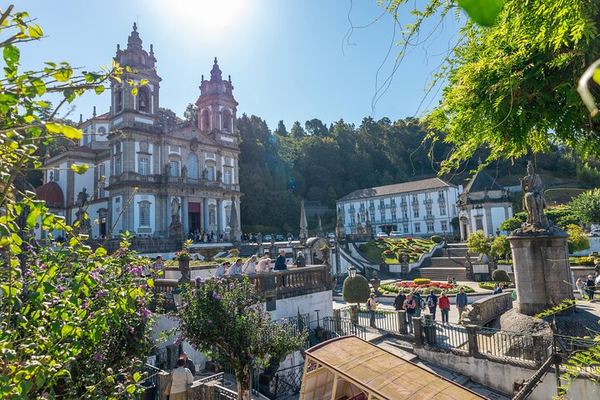
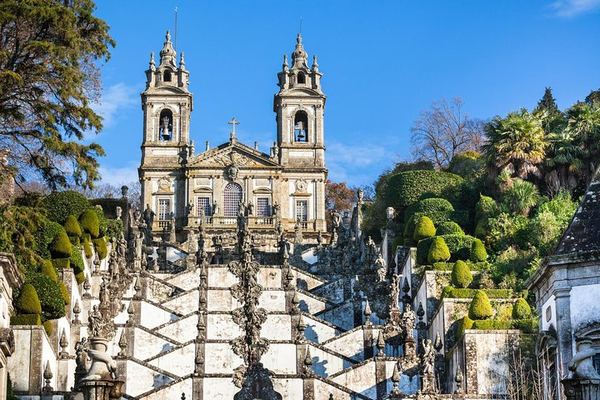
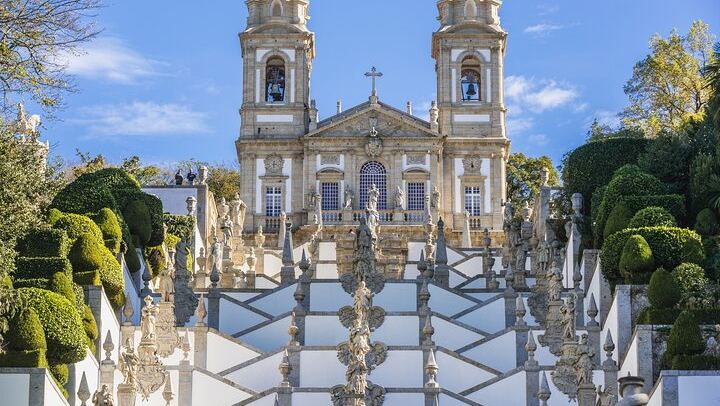
Famous for religious reasons, for its architecture, for the staircase, and for the vertical tram the staircase made necessary, which is a remarkable piece of 19th-century engineering. It was the first of its kind in Portugal, installed in 1882, and it still uses the original water-powered system to move up the 300-metre ramp in about 3 minutes. The church was built by Carlos Amarante, whose Italian-inspired neoclassical design sits in the landscape of northern Portugal without fighting it. The staircase up to it has 17 landings, each with symbolic fountains, allegorical statues and Baroque decoration on a theme: the Stations of the Cross, the Five Senses, the Virtues, Moses receiving the Commandments, and at the top the eight biblical figures who contributed to the condemnation of Jesus. The view to take is the one from the bottom, looking up: the granite fountains on each landing, and the white chalice shape the church appears to stand in.
Se de Braga
The first cathedral, older than Portugal. Braga Cathedral was the first cathedral in the country, built decades before the country was founded. Work started at the end of the 11th century, and Bishop Pedro consecrated it to the Virgin Mary in a solemn session on 28 August 1089. It competed for power with the Cathedral of Santiago de Compostela and it is the great building of the city. D. Henrique and D. Teresa, the parents of the first king of Portugal, are buried in the Chapel of Kings.
Braga
Time for a break. Free time in Braga to walk it at your own pace or eat something. The old streets, the shops, and whatever else you find.
Guimaraes
Then a short drive to Guimarães. It is called the birthplace of Portugal because Afonso Henriques, who became the first king, was born here.
Guimaraes Castle
The castle carries the mix of legend, poetry and heroism that surrounds the beginning of Portuguese history. On this Monte Largo, the Broad Hill, the nucleus of the future country took shape. Around 968, Mumadona, countess of Galicia, ordered a castle built here so the population could take refuge from the raids they were under: Vikings arriving by sea from northern Europe, and Muslims coming up from the territories they held to the south. When Count Henry took over the governorship of the province of Portucalense from his father-in-law, Alfonso VI of León, he ordered something larger and more solid. That is the defensive structure standing today, with the square keep between the four towers guarding the corners of the walls. It is not strictly documented, but the building against the inner face of the north wall was very probably Count Henry's residence, and the birthplace of his son Afonso Henriques, the first king of Portugal.
Igreja de Sao Miguel do Castelo
The small church of S. Miguel do Castelo was built in the 13th century. Tradition holds that it went up in the 12th, built by Count Dom Henrique, Henry of Burgundy, and that he baptised his son there, the first king of Portugal, Dom Afonso Henriques. It is Romanesque and small, and the decoration is plain. Under the floor lie the great warriors of the founding period of the country.
Centro Historico de Guimaraes
The historic centre, the part that stood inside the Guimarães walls, is tied to the formation and the identity of Portugal, and it was made a World Heritage site for the honesty of its restoration. The fabric is intact: iron verandas, granite balconies and porticos, mansions, arches thrown across the narrow streets, paving worn smooth, towers and cloisters. For a moment the medieval version of the place is legible, with the houses the nobility built over the centuries, the Mota Prego house, the Vila Flor and Toural palaces, and the rest of what makes Guimarães what it is.
R. de Alexandre Herculano, Porto
Rua de Alexandre Herculano, next to Praça da Batalha.
Not included
- Gratuities
- Personal expenses
- Hotel Pick Up and Drop Off
- Lunch
Good to know
- Specialized infant seats are available
- Suitable for all physical fitness levels
- Duration: the hours of duration are approximate 9 hours, The Tour is subject to local traffic, visit schedules, etc
- Please kindly note that access that the castle of Guimaraes has limited access and the access to the walls are now prohibited.
Show 7 moreShow less
- Tours are usually in one language, but a second language may be used.
- Group size maximum capacity is 27 people.
- Discover Porto in a unique way with a Free Walking Tour with Living Tours, available to all customers who book this activity. Our Free Walking Tour is available on a daily basis, in English and Spanish, at 9:30 a.m. and 4:30 p.m. departing from Living Tours Agency located in Rua Mouzinho da Silveira 352, 4050-418 Porto
- Please note: this activity is available with different ticket options, with or without entrance fees included for Guimarães Castle and Braga Cathedral.
- Up to 15 travelers per booking.
- Mobile or paper ticket accepted
- Guiding available in: pt, en, fr, es.
Reviews
Loading reviews…