Castles · Tour
Guimarães Walked Downhill and Braga with Sameiro, Back by Five
A full day across the Minho, the country of the Vinho Verde, and into the two cities that hold the architecture: Guimarães first, Braga after. Guimarães is where Portugal began, and its centre has been a UNESCO World Heritage Site since 2001. The castle dates from the 10th century, and the tour starts up there and walks down, which is both the easier direction and the chronological one. The Dukes of Bragança Palace is on the way, along with streets and squares that have not been rebuilt. Braga follows. It was a Roman city before it was one of the most important Christian centres in Portugal. Lunch is traditional, with Vinho Verde. The afternoon covers the 11th-century Cathedral, Bom Jesus do Monte, and the Sameiro Sanctuary, which almost no day trip from Porto includes. Back in Porto at around 5pm.
What's included
- Small goup tour - Maximum up to 8 people
- Entrances to monuments included
- Expert tour guide
- Hotel pick up and drop off
Show 1 moreShow less
- Premium air-conditioned vehicle
Itinerary
The map could not be loaded. Please try again in a moment.
Guimaraes Castle
In Guimarães the tour starts at the top of the city, where the castle is. The guide covers the early history of Portugal as the group passes the oldest medieval castle in the country and starts the walk down into the centre.
Igreja de Sao Miguel do Castelo
The church dates from the 13th century and is classified as a national monument. It is Romanesque, and it was rebuilt at the start of the 20th century to its original appearance. The legend attached to it is that the first king of Portugal, D. Afonso Henriques, was baptised here.
Paco dos Duques de Braganca
The palace dates from the beginning of the 15th century, built on the order of D. Afonso, son of King João I, at the time of his marriage to D. Constança de Noronha. It was put to several uses over the centuries and suffered for it. Restoration began at the start of the 20th century. It is a national monument and now a museum, holding tapestry, furniture, Chinese porcelain and paintings.
Rua de Santa Maria
Coming down towards the residential part of the city, the route passes along Rua de Santa Maria, one of the first streets in Guimarães, which was the main link between the convent of D. Mumadona Dias, the houses and the castle.
Praca de S. Tiago
This is the square the people of Guimarães use, with the restaurants, the bars and the terraces, surrounded by the architecture the city is known for. The legend has it named for the apostle James, who left an image of the Virgin Mary here on a pilgrimage. A church was built on the spot in the 12th century and demolished in the 19th.
Largo da Oliveira
Largo da Oliveira is the most emblematic of the historic squares of Guimarães. The name comes from an old olive tree, a symbol of peace and of continuity. A good deal has happened here over the centuries, including medieval courts and several of the moments that made Portugal a country.
Padrao do Salado
Besides the church, Largo da Oliveira holds the Padrão do Salado, the monument to the victory of D. Afonso IV over the Moors at the battle of Salado in 1340.
Igreja de Nossa Senhora da Oliveira
From Largo da Oliveira you can see the church of Nossa Senhora da Oliveira, the Colegiada de Guimarães, which goes back to a monastery founded in the first half of the 10th century by Countess Mumadona Dias. The building standing now went up in 1387 on the order of King João I, on Gothic models.
Se de Braga
Braga Cathedral is one of the emblematic historic monuments of Portugal, and the measure of how much of the country's culture came through the church. Construction dates from the end of the 11th century, and Bishop D. Pedro consecrated it to the Virgin Mary in 1089. It is the first Portuguese cathedral, built several decades before the nation itself.
Bom Jesus Do Monte
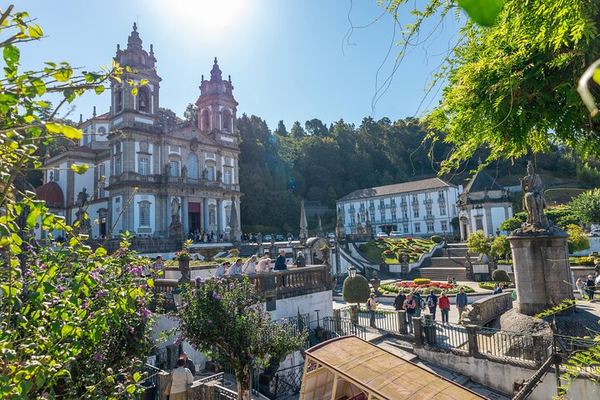
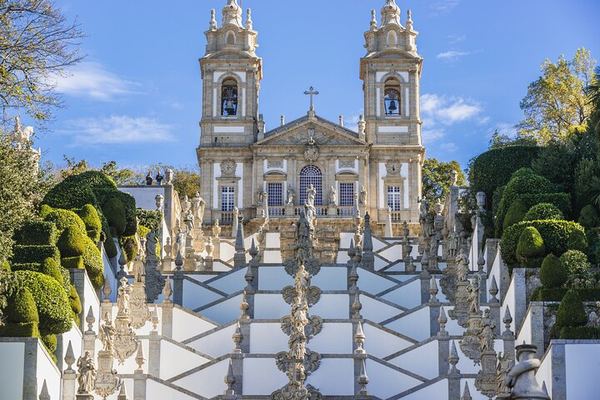
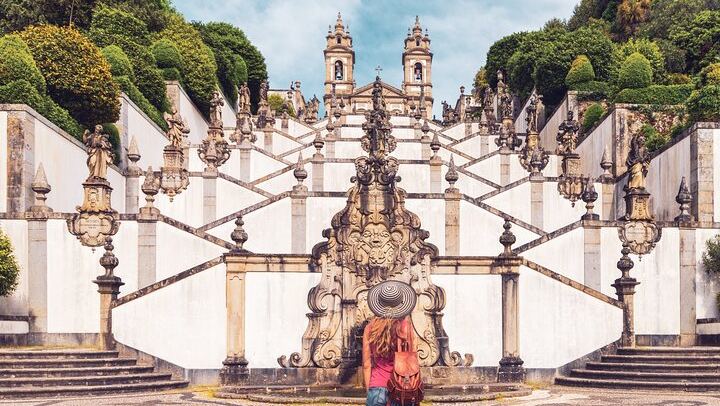
The Bom Jesus do Monte sanctuary is a piece of religious architecture and landscape design in one, above Braga. It has over 600 years of history as a place of Christian pilgrimage, and it is one of the clearest European examples of a Sacro Monte, the form that appeared after the Council of Trent in the 16th century. The Via Crucis climbs the hillside through chapels, fountains and sculpture representing the Passion, ending at the neoclassical church built between 1784 and 1811. The Staircase of the Five Senses is the Baroque set piece, working through the human senses in fountains and statues. UNESCO listed Bom Jesus do Monte as a World Heritage Site in 2019, for the way it sits in the landscape as much as for what it is. From the top the view runs across Braga and the country around it.
Not included
- Gratuities
- Lunch
Good to know
- Specialized infant seats are available
- Suitable for all physical fitness levels
- Travel time is already included with the total tour duration.
- Green wine - legal age to drink is 18 years old and above
Show 3 moreShow less
- Up to 8 travelers per booking.
- Mobile or paper ticket accepted
- Guiding available in: pt, en.
Reviews
Loading reviews…