Castles · Tour
The Whole City Privately, from Expo 98 to Belém and Across to Cristo Rei
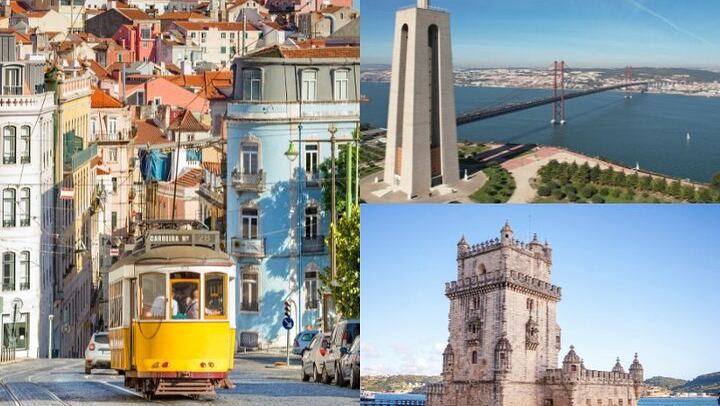
Lisbon end to end, privately, and then over the river for the view back at it. The route runs from the Parque das Nações built for Expo 98 in the north-east, through Alfama, the castle and the downtown, out to Belém in the west, and across the Tagus to the Cristo Rei on the south bank, which is where the best view of the city is. Being private, the itinerary is a proposal rather than a schedule. The stops and the timings can be rearranged around what you actually want to see, and the operator, Yellow Cab TT Tours, expects to be told.
What's included
- Hotel pickup and drop-off
- Private tour
- Transport by air-conditioned minivan
Itinerary
The map could not be loaded. Please try again in a moment.
Parque Das Nacoes
The northern edge of Lisbon, the Parque das Nações, was built for the Expo 98 world exhibition, which is when the city finally got its river back. It sits on the Tagus estuary, a new and deliberately modern quarter, with a view of the Vasco da Gama Bridge, the longest in Europe, and a run of contemporary architecture and engineering along the water. This is a private tour: every timing and stop suggested here can be changed to suit you. Say the word and it is done.
Vasco da Gama Tower BABYLON 3600
The Vasco da Gama Tower is a 145-metre lattice tower at Parque das Nações. It stands on the north bank of the Tagus and takes its name from the 15th-century Portuguese explorer.
Centro Vasco da Gama
Built as the main entrance to the EXPO 98 world exhibition, and the clearest statement of the modern architecture and engineering that define the Parque das Nações.
Estacao do Oriente
Designed by the Spanish architect Santiago Calatrava and opened on 19 May 1998, as part of the celebrations for EXPO'98. When it opened it was the largest intermodal station in Portugal, and it won the Brunel Award in the category for large new construction.
Alfama
Alfama is the oldest quarter of Lisbon, on the slope between São Jorge Castle and the Tagus. The name comes from the Arabic Al-hamma, hot springs or baths. It holds a great deal of the city's history, and most of its fado houses and restaurants.
Castelo De Sao Jorge
The hill under São Jorge Castle has been occupied by Phoenicians, Romans, Visigoths and Moors in turn, because of where it sits. Since 1147, when D. Afonso Henriques took Lisbon, the castle has been a royal palace, a barracks, the national archive, and now a national monument and museum.
Miradouro Da Senhora Do Monte
One of the highest viewpoints in Lisbon, looking down over the old quarters of Mouraria and Graça with the main landmarks along the horizon. The stop everyone takes photographs at.
Lisbon Cathedral
The oldest church in the city. Built after D. Afonso Henriques took Lisbon in 1147, the cathedral has come through several earthquakes and been altered, renovated and restored repeatedly. What stands now is a mix of styles, classified as a National Monument in 1910.
Praca Martim Moniz
The legend has Martim Moniz as a knight at the Siege of Lisbon under King Afonso Henriques, who threw himself into the castle gateway so the defenders could not close it. That act is why one of the squares in the downtown carries his name, and it is now the square where the largest number of the world's cultures meet in this city.
Praca Da Figueira
In the 16th century there was no square here. Most of the ground was taken by the Hospital Real de Todos os Santos, the most important in Lisbon. The 1755 earthquake wrecked the hospital, and it was demolished around 1775. The ground it left became an open market, and in the late 19th century a large covered market was built on it. That lasted until 1949, when it came down. The square has been open ever since.
Praca Dom Pedro IV
Officially the square of King Pedro IV, and Rossio means a large open gathering ground. It is the centre of the Baixa, surrounded by late 18th-century buildings from the reconstruction plan Marquês de Pombal ordered after 1755. From here the pedestrian streets run down to the river, through Rua Augusta and Praça do Comércio.
Praca do Comercio
Usually called Terreiro do Paço, because the Paços da Ribeira, the royal Ribeira Palace, stood here until the 1755 earthquake. After that the square was rebuilt from scratch as part of the plan of Marquês de Pombal, Sebastião José de Carvalho e Melo. It is still one of the largest city squares in Europe.
Rua Augusta
The main pedestrian street of the Lisbon downtown, running from Rossio to Praça do Comércio. Near the river end stands the Arco da Rua Augusta, the enormous triumphal arch built in the 19th century for the rebuilding of the city after 1755.
Praca Dos Restauradores
Surrounded by 19th and early 20th-century buildings, this square is dedicated to the restoration of Portuguese independence on 1 December 1640, after sixty years of Spanish rule. The obelisk in the middle, from 1886, carries the names and dates of the battles of the Restoration War. Avenida da Liberdade starts here, the main boulevard of the city, with wide pavements laid in Portuguese calçada, still set by hand, one light or dark stone cube at a time.
Marques Do Pombal
Sebastião José de Carvalho e Melo was secretary of state to King José I at the time of the 1755 earthquake. Among a great deal else, he was the master planner of the reconstruction of the Lisbon downtown. The statue here, from the 20th century, is the city acknowledging that.
Parque Eduardo VII
A public park of 26 hectares next to Avenida da Liberdade and Marquês de Pombal square. It is named for King Edward VII of the United Kingdom, who came to Portugal in 1902 to strengthen relations between the two countries.
Bairro Alto
One of the historic quarters of Lisbon, which grew out of the economic expansion of the city after the 16th century. Population growth and commercial development forced the city outwards, and what went up was a dense residential and commercial district that has kept its character. Next to Bairro Alto, Chiado runs down towards the downtown and has become the art and fashion quarter.
Basilica da Estrela
Queen Maria I of Portugal ordered the basilica built in fulfilment of a vow. It came out of her particular devotion to the Sacred Heart of Jesus, and it remains the most important architectural undertaking of her reign. The church is huge, with an enormous dome, standing on a hill in what was then the western edge of Lisbon and visible from a long way off. The style follows the Mafra National Palace: late baroque and neoclassical, with twin bell towers in front of statues of saints and allegorical figures.
Ponte 25 de Abril
The main crossing between the south of Portugal and the centre. Finished in 1966, it shares its design concept with the San Francisco-Oakland Bay Bridge, and it is one of the most photographed things in Lisbon.
Santuario Nacional de Cristo Rei
The best view of Lisbon is from the south bank of the Tagus. Over 100 metres high and finished in 1959, the monument was built to fulfil a vow made by the Portuguese episcopate that the country would be kept out of the Second World War.
Costo extra
Jeronimos Monastery
The monastery is the most prominent example of the Portuguese Late Gothic Manueline style in Lisbon. UNESCO listed it as a World Heritage Site in 1983. Construction began in 1501 and took over 100 years.
Costo extra
Torre de Belem
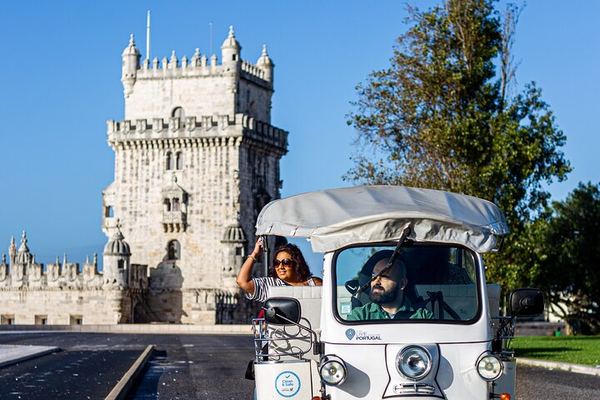
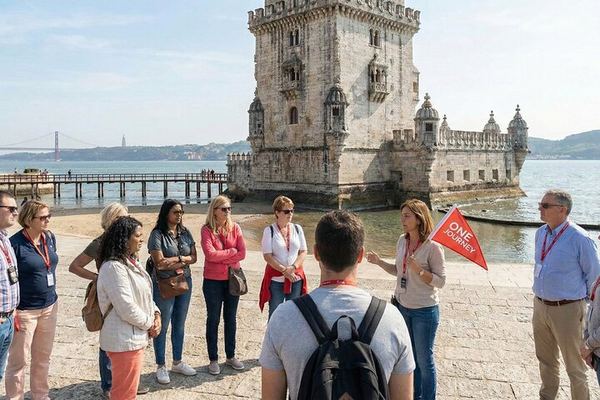
Built in 1520, and one of the images the whole world recognises as Lisbon. King Manuel I ordered the fortified tower put up near the harbour the Portuguese caravels sailed from, to protect a city that was growing fast. The stop everyone takes photographs at.
Costo extra
Padrao Dos Descobrimentos
Built in 1940 for the Great Exhibition of the Portuguese World held that year, the Padrão dos Descobrimentos marks the Portuguese Age of Discoveries. It was rebuilt in 1960 for the 500th anniversary of the death of Henry the Navigator, the man who drove the Portuguese expansion overseas.
Not included
- Lunch
- Tips
Good to know
- Specialized infant seats are available
- Infants and small children can ride in a pram or stroller
- Service animals allowed
- Public transportation options are available nearby
Show 5 moreShow less
- Not recommended for travelers with poor cardiovascular health
- Suitable for all physical fitness levels
- Up to 8 travelers per booking.
- Mobile or paper ticket accepted
- Guiding available in: pt, en, fr, es.
Reviews
Loading reviews…