Castles · Tour
Twenty-Four Stops by Tuk-Tuk, Four Viewpoints, Alfama to Belém
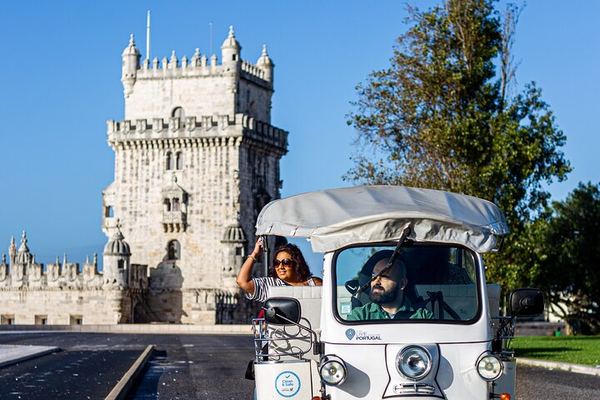
Lisbon by tuk-tuk with a local guide, covering the old town, the centre and Belém in one run. The tuk-tuk is the point: it gets up the gradients and into the streets of Alfama that nothing larger can enter, which is how a route this long fits into a short amount of time. Twenty-four stops, four of them viewpoints, from the cathedral in Alfama out to the Jerónimos Monastery, with the guide filling in the history between them.
What's included
- Bottled water
- Driver
- hotel pick and even drop-off at any location
- Transportation
Itinerary
The map could not be loaded. Please try again in a moment.
Pç. de S. Paulo 17, Lisboa
You are picked up at the agreed meeting point. The driver and guide will contact you before the pickup and will be easy to spot: look for the tuk-tuk, which is usually parked there a little before the departure time.
Lisbon Cathedral
Lisbon Cathedral, the oldest church in the city, known for its architecture and for sitting right in the middle of Alfama.
Costo extra
Miradouro Das Portas Do Sol
A stop at the Portas do Sol viewpoint, over the roofs of Alfama and the Tagus behind them.
Miradouro da Graca
The Miradouro da Graça is the viewpoint in the old Graça quarter. It takes in São Jorge Castle, the Tagus and the downtown in one sweep. It is a local spot rather than a tourist one, and it fills up at sunset for the light.
Miradouro Da Senhora Do Monte
A stop at the Senhora do Monte viewpoint, which has the best panorama over Lisbon of any of them.
Mosteiro de Sao Vicente de Fora
The Monastery of São Vicente de Fora is one of the most important historic and religious buildings in Lisbon. It stands in Alfama and was founded in 1147 by King Afonso I after the Christian reconquest of the city. What stands now was built mainly in the late 16th and early 17th centuries.
Costo extra
Panteao Nacional
The National Pantheon is one of the emblematic monuments of Lisbon. It occupies the former Church of Santa Engrácia, a Baroque building begun in 1681 that took nearly 300 years to finish.
Costo extra
Alfama
The lower part of Alfama is the most traditional part of Lisbon, narrow streets and a great deal of history in a small area. The restaurants and the fado houses are here, with live fado sung over dinner, which is as close to the real thing as a visitor gets. It fills up in the evening, with locals as well as visitors.
Praca do Comercio
The Praça do Comércio, often called Terreiro do Paço, is one of the best known places in Lisbon and one of the largest public squares in Europe.
Time Out Market Lisboa
A modern food hall where a number of the best known chefs and restaurants in Lisbon each run a small counter under one roof.
Pink Street
Pink Street is the centre of Lisbon nightlife. Its real name is Rua Nova do Carvalho, but the road surface was painted bright pink during an urban renewal scheme and the name stuck.
Largo do Carmo
The Largo do Carmo is a historic square in central Lisbon, known for its part in the Portuguese democratic revolution and for the ruins of the Carmo Convent standing over it.
Costo extra
Igreja de Sao Roque
The Church of São Roque is one of the more remarkable churches in Lisbon. The outside is plain, which is the joke, because the interior is gilded chapel after gilded chapel, with marble and Baroque work on every surface.
Miradouro Sao Pedro de Alcantara
The Miradouro de São Pedro de Alcântara is one of the best known viewpoints in Lisbon, with the whole city laid out across the valley.
Avenida da Liberdade
Passed on the way.
Assembleia Da Republica
The Assembleia da República is the Portuguese parliament and the country's only legislative chamber. It represents every citizen, passes the laws and holds the government to account, at the centre of the democratic system built after the Carnation Revolution of 1974 and the Constitution of 1976.
Costo extra
Basilica da Estrela
Maria I of Portugal commissioned the basilica to fulfil a vow: she had promised a church if she were given an heir to the throne. Construction began in 1779 and finished in the late 18th century.
Costo extra
Parque Eduardo VII
Parque Eduardo VII is the large public park in central Lisbon, named after Edward VII, who came to Portugal in 1903 to strengthen relations between the two countries.
It’s a historic pastry shop and café located in the Belém…
A historic pastry shop and café in Belém, next to the Jerónimos Monastery. It has been making custard tarts since 1837, to a secret recipe said to have come from the monks at the monastery next door.
Padrao Dos Descobrimentos
A large stone monument to the Portuguese Age of Exploration of the 15th and 16th centuries, when Portuguese voyages connected Europe, Africa, Asia and South America. It was first built in 1940 as a temporary structure for an exhibition, then rebuilt permanently in 1960.
Torre de Belem
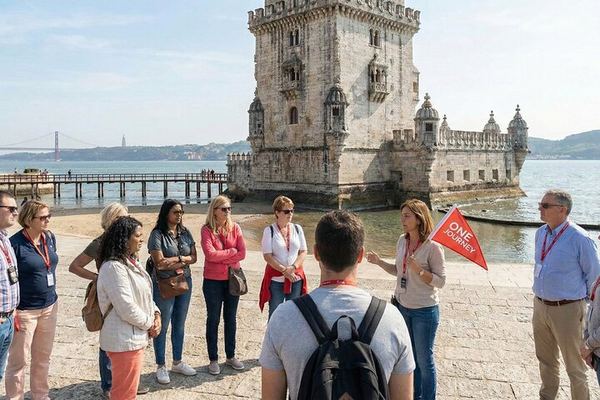
Built in the early 16th century under King Manuel I, the tower was designed as a fortress to defend the entrance to the Lisbon harbour. Later it served as a customs post and a lighthouse.
Jeronimos Monastery
A 16th-century monastery built under King Manuel I, raised to mark the Portuguese Age of Exploration and to pray for the sailors leaving on the long voyages.
Costo extra
Palacio Nacional da Ajuda
The Belém Palace is the official residence of the President of Portugal and one of the most important state buildings in the country.
Costo extra
MAAT - Museu de Arte, Arquitetura e Tecnologia
The MAAT is a contemporary museum that puts art, architecture and technology in the same building.
Costo extra
LX Factory
A 19th-century textile factory complex turned in 2008 into a cultural and commercial site. Rather than demolish the industrial buildings, Lisbon kept them and filled them with cafes and restaurants, art studios and design shops, bookshops and galleries, coworking space and venues.
Pç. de S. Paulo 17, Lisboa
Not included
- Entrance for monument’s pay on the site directly
- Personal expenses
- Tips/gratuities
Good to know
- Infants and small children can ride in a pram or stroller
- Service animals allowed
- Public transportation options are available nearby
- Infants are required to sit on an adult’s lap
Show 6 moreShow less
- Specialized infant seats are available
- Not recommended for travelers with poor cardiovascular health
- Travelers should have at least a moderate level of physical fitness
- Up to 13 travelers per booking.
- Mobile or paper ticket accepted
- Guiding available in: de, en, it, fr, es.
Reviews
Loading reviews…