Castles · Tour
You Drive the Twizy, the GPS Does the Talking, Alfama to Belém
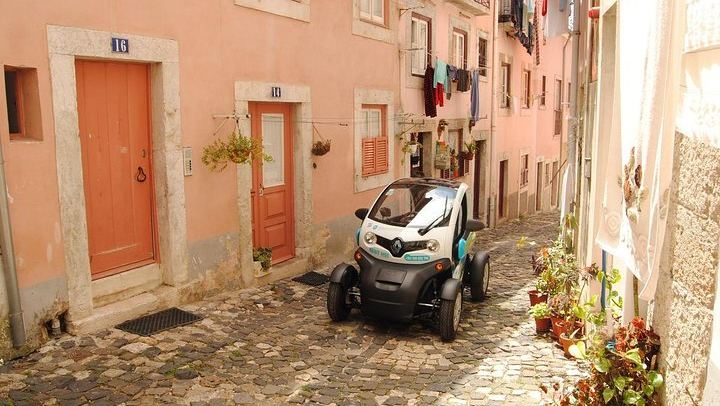
A battery-powered two-seat Twizy, and you are the one driving it, through Alfama, Graça and Belém. The route covers the old city and then the Belém waterfront, which is where the explorers left from to go and take on the rest of the world. Small enough to get through the streets of Alfama, which rules out anything larger. The commentary comes from a GPS audio guide that triggers as you reach each place, with the history and the stories attached to it. No group to keep up with, no guide to wait for, and you stop where you want to stop.
What's included
- GPS audio guide
- Car insurance
- Free parking
- Time to stop at the various points of interest to get a closer look (e.g. churches, viewpoints etc.
Itinerary
The map could not be loaded. Please try again in a moment.
R. da Madalena 67, Lisboa
Departure point: downtown Lisbon, 100 metres from Comércio Square and the Cathedral. Metro: Terreiro do Paço, blue line.
Castelo De Sao Jorge
São Jorge Castle is one of the emblems of Lisbon. The outline is recognisable by day and lit at night, on the summit of São Jorge hill, the highest in the city. Two quarters sit on the slope below it, Alfama and Castelo. The Visigoths built a small fortress here in the fifth century. The Moors rebuilt and enlarged it in the mid-eleventh, it was altered again under Afonso I of Portugal (1109-1185), and later turned into a royal palace. It was fully restored in 1938.
Costo extra
Jeronimos Monastery
The Jerónimos Monastery, also called the Hieronymites Monastery, is one of the most visited places in Lisbon. UNESCO declared it a World Heritage Site in 1983. In Portuguese it is the Mosteiro dos Jerónimos. The Portuguese architect Diogo de Boitaca designed it to mark the return of Vasco da Gama from India. Construction began on 6 January 1501 and was not finished until the seventeenth century. The style is predominantly Manueline, the Portuguese late Gothic. It stands on the site of the old Ermida do Restelo, the chapel where Vasco da Gama and his crew prayed before sailing down the African coast to India.
Costo extra
Alfama
Alfama is the most authentic quarter in Lisbon. Old coloured buildings, close together, and a character somewhere between cheerful and quiet depending on the hour.
Panteao Nacional
The National Pantheon is a symbol of Portuguese identity, holding the men and women the country owes something to. It is the highest posthumous honour Portugal grants, and the building keeps that memory in one place.
Costo extra
Praca do Comercio
Praça do Comércio, Commerce Square, is the main square of Lisbon. It stands where the old Royal Palace stood until the 1755 earthquake destroyed it. The south side is open to the Tagus. The other three carry yellow buildings with arcades running the full length of the facades. When the square was new, the merchant ships unloaded straight onto it, because this was the door into Lisbon. The Cais do Sodré ferry terminal is on the bank nearby, and several ferries leave from there down the Tagus.
Igreja de Sao Vicente de Fora
The Church and Monastery of São Vicente de Fora is one of the historic buildings of the capital, dedicated to the patron saint of the city since 1173, São Vicente. The origins go back a long way: the troops of D. Afonso Henriques are said to have camped here during the taking of Lisbon from the Moors in 1147. The building standing now was put up between 1582 and 1629.
Costo extra
Museu do Fado
Fado is the one thing to hear in Lisbon. It is a genre that came out of the Portuguese themselves, and it carries the history of the country in it. There are several kinds, and all of them run on mournful melody and a lyric that hurts. The word for it is saudade: nostalgia, and the longing for something that is gone. Fado does something to people who hear it properly, which is why it keeps being recommended.
Torre de Belem
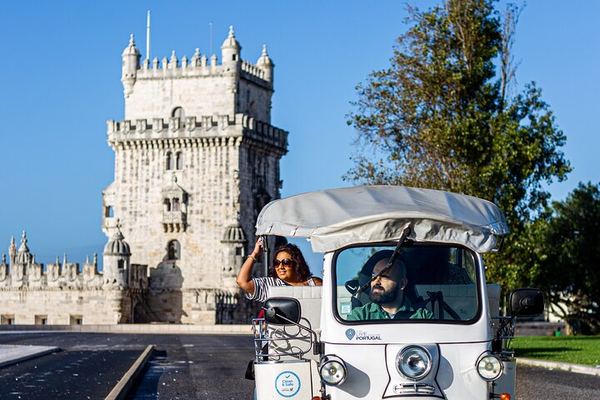
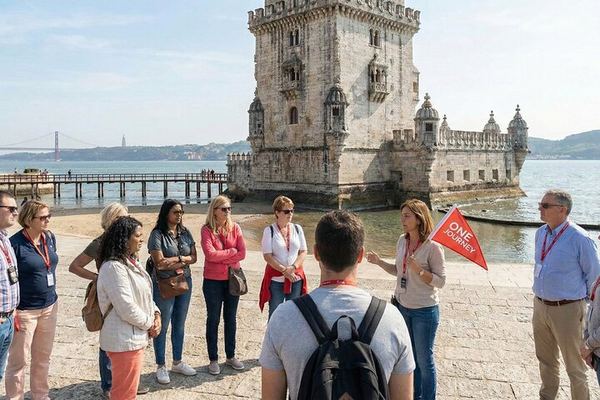
The Belém Tower was built between 1514 and 1520 in the Manueline style by the Portuguese architect and sculptor Francisco de Arruda. UNESCO classified it as a World Heritage Site in 1983. It was built on the north bank of the Tagus to defend the city. Later it served as a lighthouse and a customs house.
Costo extra
Lisbon Eco Tours
Start and finish point.
R. da Madalena 67, Lisboa
Not included
- Food and beverages
- Hotel pickup and drop-off
Good to know
- Public transportation options are available nearby
- Specialized infant seats are available
- Suitable for all physical fitness levels
- The Twizy is a two-seater car
Show 6 moreShow less
- Driving license required
- Children (under 18) must be accompanied by an adult
- Security deposit of 150€ in cash will be held until the Twizy is returned
- Up to 14 travelers per booking.
- Mobile or paper ticket accepted
- Guiding available in: pt, en, fr, es.
Reviews
Loading reviews…