
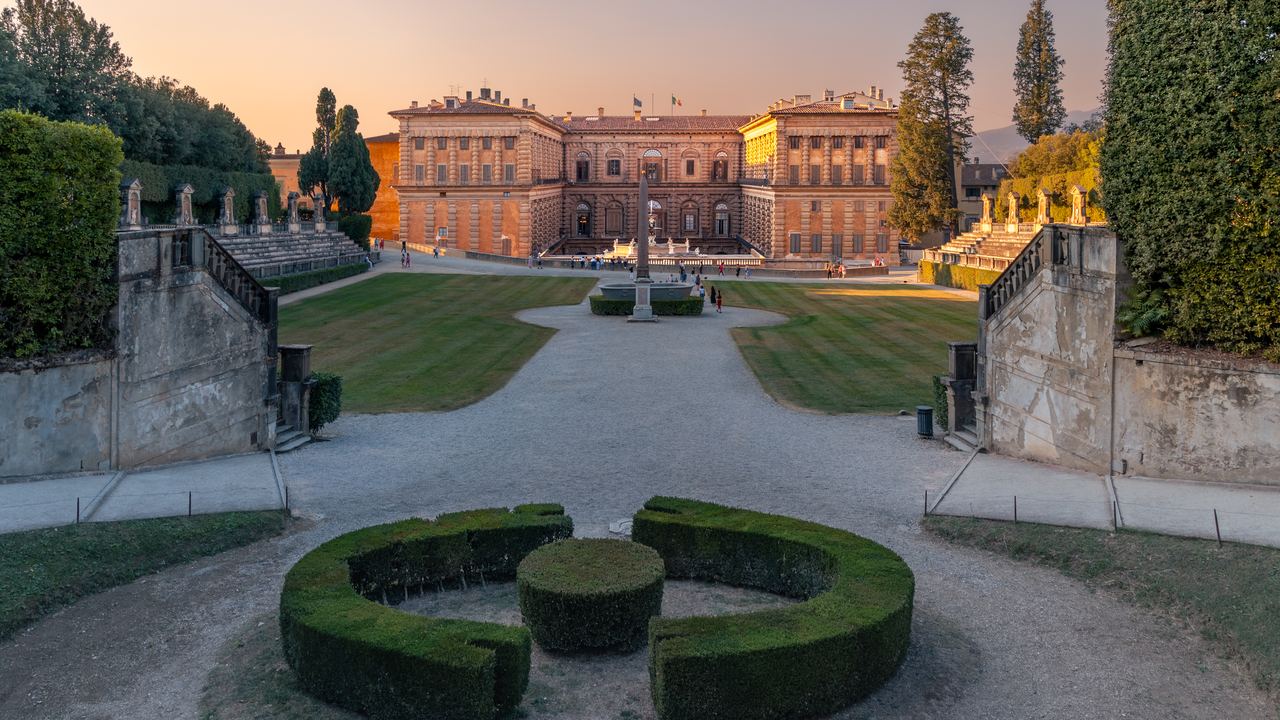
Pitti Palace and Boboli Garden Tickets
Six collections behind one 16 EUR ticket, a garden at 10, both at 22, and 3 EUR more on each if you book ahead. 16 listings on this site, median 80.50 EUR across 1,238 reviews.
Palazzo Pitti sells three tickets, and the cheapest way to hold any of them is to walk up to the desk. The palace on its own is 16 EUR at the counter and 19 booked online. The Boboli Garden behind it is 10 at the counter and 13 online. The two together are 22 and 25. That surcharge is not a rounding difference between channels, it is a flat advance booking fee of 3 EUR applied to every ticket type, and it runs in the opposite direction to Venice, where booking a month ahead takes 5 EUR off. Buy at the door here and you are 3 EUR better off, provided you are willing to arrive without a reservation.
What sits behind the 16 EUR is more than the name suggests. One palace ticket opens the Palatine Gallery with the Royal Apartments, the Gallery of Modern Art, the Museum of Fashion and Costume, the Treasury of the Grand Dukes, the Museum of Russian Icons and the Palatine Chapel: six collections on one admission. The garden ticket is similarly generous and similarly quiet about it, since it also covers the Bardini Garden and the Porcelain Museum, and the combined ticket carries the Bardini across too. A visitor who reads only the name of the ticket underbuys the building and then runs out of afternoon inside it.
Nothing here obliges you to take a guide, either. The Gallerie degli Uffizi require none and sell none on their own ticket pages: the visit is free-form, the rooms are numbered and the audio equipment is somebody else's business. Every guided product for this palace therefore comes from the market rather than from the museum, which is worth holding in mind while reading prices that run from 34 EUR to 260.
The 16 listings attached to this palace on our site carry 1,238 reviews between them, which is the thinnest evidence base of any Italian page here and a hundredth of what the Medici walking tours have collected across the river. The median is 80.50 EUR, the first quartile 68.40 and the third 165, and eleven of the sixteen finish inside two hours. Set two hours against six collections and a garden that climbs a hill, and the most common complaint in this set stops being a mystery.
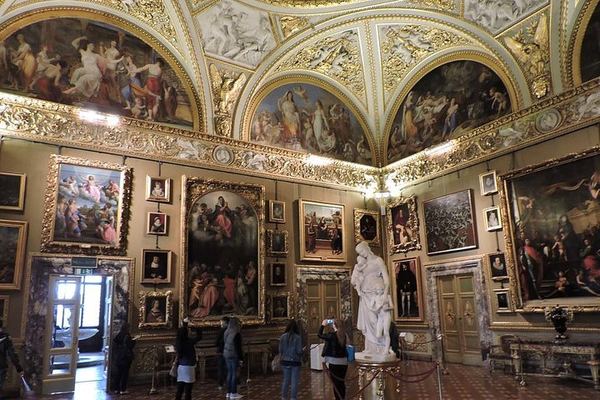
A Private Guide, the Palatina, and What Court Life Was Actually Like
A private visit to the Florentine royal palace, with the Titian, Raphael and Caravaggio the Medici collected, and the court stories that go with the rooms.
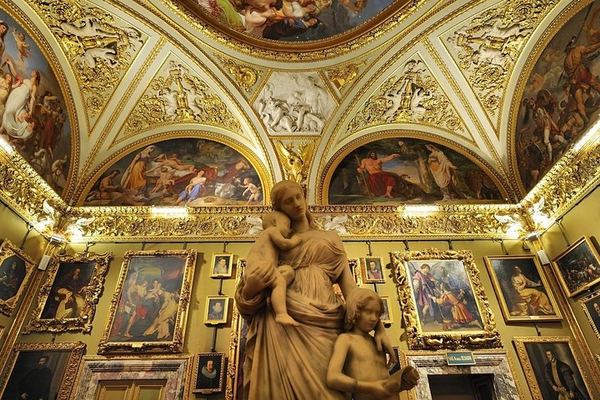
Both Medici Palaces in Four Private Hours, Tickets Not Included
Four private hours across both palaces the Medici lived in, starting at your hotel lobby. Read this bit: the entrance tickets are not in the price.

Meet by the Uffizi Exit, Finish Inside Pitti, Keep the Ticket All Day
A small group meets at an office by the Uffizi exit, walks in through the priority entrance, and leaves you inside with a ticket good for the rest of the day.
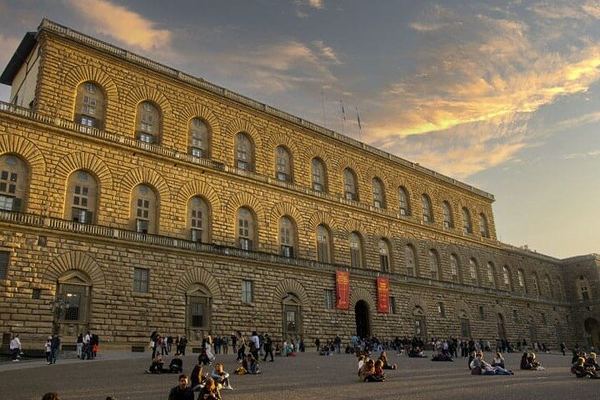
Priority Entry, Self-Guided, and Boboli Only If Your Option Has It
Reserved entry and no guide, so the pace is yours across the Palatina, the Royal Apartments and the fashion museum. Boboli depends on the option you pick.
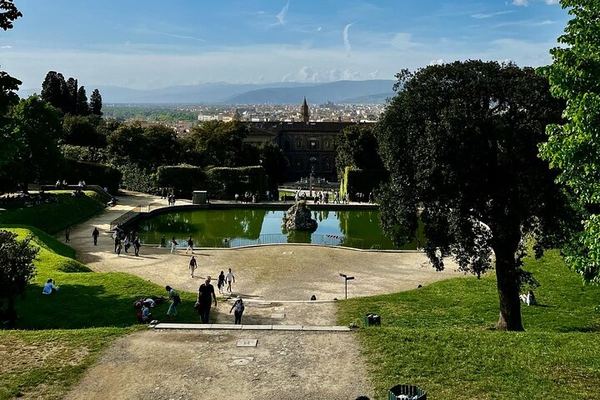
The Guide Does the Palace, the Eleven Acres of Boboli Are Yours Alone
The guided half covers the palace of 1458 and the Palatina; the garden you walk alone, 11 acres of it, up to the 360-degree view from its highest point.

The Last Medici: Anna Maria Luisa, and Four Museums Under One Roof
The palace holds four museums, not one, and the story runs to Anna Maria Luisa, the last Medici. The Boboli ticket is handed over at the end for you alone.
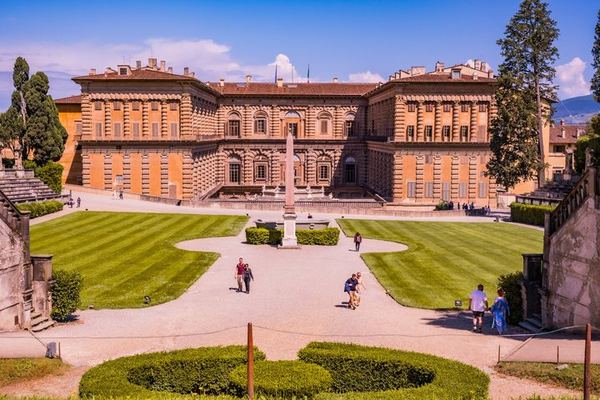
The Ticket Lasts 24 Hours, and Boboli Is What Versailles Copied
Two guided hours and then the ticket stays valid for 24, so you can come back. Boboli was the model for the European royal gardens, Versailles included.
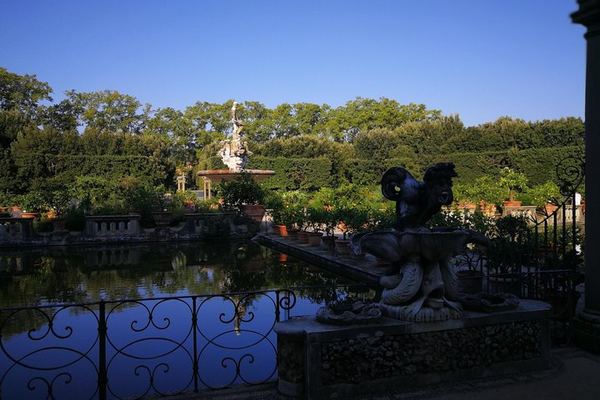
One Facade, Four Dynasties Inside: Pitti, Medici, Habsburg, Savoy
The outside has not changed in centuries while the rooms inside changed with every family that took it, from the Pitti to the Savoy. Palatina and Boboli both.

The Palatina Alone in Two Hours, Fourteen People, No Boboli
Two hours on the Palatina and nothing else, in a group capped at fourteen, with the paintings still hung in the apartments the grand dukes lived in.
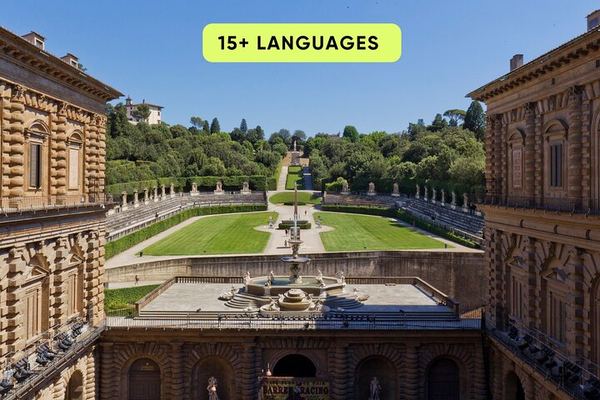
One Fixed Uffizi Slot, Then Five Days for the Pitti and Boboli
The clock starts at the Uffizi, the only visit with a set date and time. The Pitti and Boboli follow whenever you like within five days. Sales are final.
Three Days to Cancel, Skip the Queue, and Stay On After the Guide Goes
A guided visit through the Palatina and the royal apartments, with entry past the queue and a cancellation window that closes three days out, not the usual one.
Pietro da Cortona's Planetary Rooms and the King of Italy's Apartments
Ninety minutes through the Planetary Rooms Pietro da Cortona painted, ending in the royal apartments the King of Italy lived in. Stay on after if you want.
The Paintings Are Still Hung Where the Lorraine Put Them, Not by Date
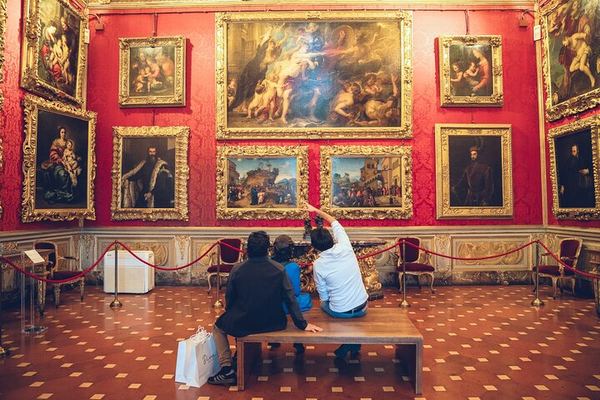
The pictures sit where the Lorraine grand dukes hung them, arranged by their taste rather than by date, which is why this reads as a house and not a museum.
Five Sections on One Ticket, and It Needs Four People to Run
The ticket covers five sections including the Royal and Imperial Apartments. Worth knowing: it takes four bookings to run, or you are refunded in full.

Two eBooks Instead of a Guide, and the Woman Who Bought the Palace
No guide: the entry plus two eBooks written by art historians, to read at your own pace. Eleonora di Toledo was the one who bought this palace, in 1550.
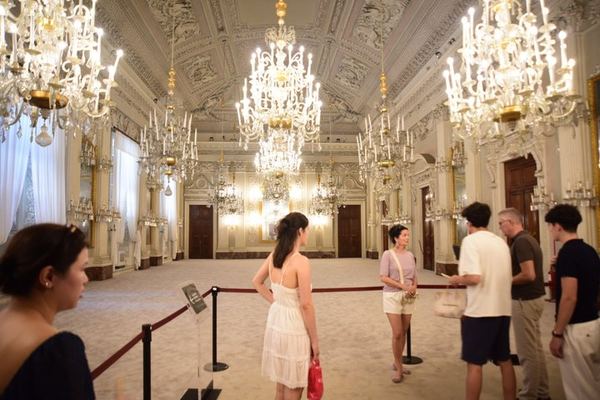
Twenty-Eight Rooms with a Guide, and Five Years as Italy's Royal Palace
Two hours with a guide through the 28 rooms of the Palatina, then free time for the modern art, treasury and costume museums. The palace was royal from 1865.
Ratings collected by Viator, Tripadvisor and Civitatis
The fee that punishes planning
The Gallerie degli Uffizi publish one list for the counter and one for advance sale, and the gap between them is a constant 3 EUR whichever ticket you take. It is worth saying plainly because the instinct built by every other monument in this catalogue is the opposite: in Venice the advance ticket is the discount, at Neuschwanstein the slot is the whole product, and here the reward for organising yourself is a surcharge. Whether that 3 EUR is worth paying comes down to one question, which is whether the museums have a time slot at all, and the honest answer is that we could not establish it. The official pages describe the binding slot only for the Uffizi. For the Pitti and Boboli tickets bought on their own, the ticketing site returned no readable rules when we checked it.
The reduced rate is 3 EUR flat, which is a fifth of the adult price, not the usual two thirds, and entry is free for everybody on the first Sunday of every month. Neither of those is sold by any reseller, here or anywhere else, for the obvious reason that there is no commission in them.
| Ticket | At the counter | Booked ahead | What it opens |
|---|---|---|---|
| Palazzo Pitti | 16 EUR | 19 EUR | Palatine Gallery and Royal Apartments, Modern Art, Fashion and Costume, Treasury of the Grand Dukes, Russian Icons, Palatine Chapel |
| Boboli Garden | 10 EUR | 13 EUR | The garden, plus the Bardini Garden and the Porcelain Museum |
| Both, valid one day | 22 EUR | 25 EUR | Everything above, Bardini included |
| Passepartout, 5 consecutive days | 40 EUR, or 58 with the Vasari Corridor | Not published separately | Uffizi, Pitti and Boboli, one entry each |
| First Sunday of the month | Free | Not applicable | The museums, at no charge |
The garden keeps a different Monday
The museums inside the palace are open Tuesday to Sunday, 8:15 to 18:30, and closed every Monday. The Boboli Garden is not: it closes only on the first and last Monday of each month. On the second, third and sometimes fourth Monday of a month the garden is open while the palace it belongs to is shut, and a combined ticket bought for that day still buys you half of what it says. Nobody is going to stop you using it, and nobody at the desk is going to volunteer the arithmetic either.
The garden also runs on its own clock through the year. It opens at 8:15 in every month and closes at 16:30 in January, February, November and December, at 17:30 or 18:30 through spring and autumn depending on the change of hour, and at 19:10 in June, July and August. Last admission is one hour before closing in every case, so a December arrival at half past three is an arrival after the gate has stopped letting people in. The palace shuts on 1 January and 25 December; the garden closes only on 25 December, and stayed open on 1 January 2026 when the museums did not.
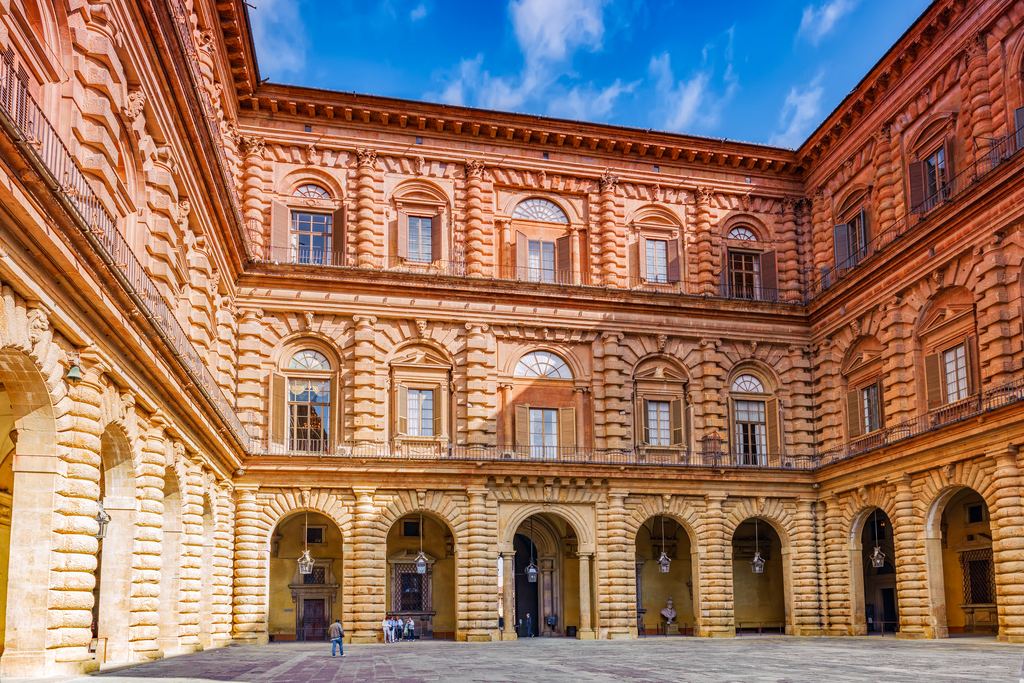
The courtyard where a card becomes a ticket
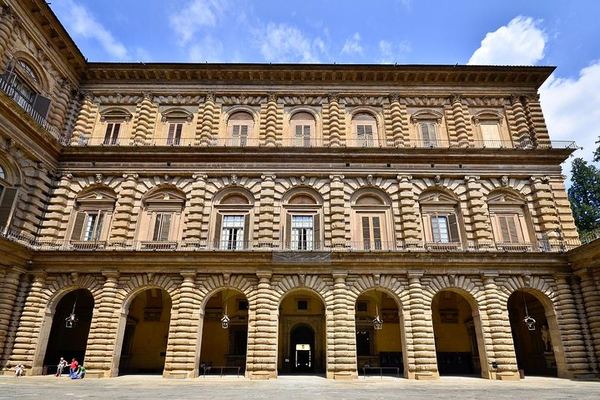
Ammannati's courtyard, the block of heavy rusticated stone between the two wings, is where the palace does its administration. Holders of the Firenze Card cannot walk straight in on the card: they collect an entry coupon at the Pitti ticket office here first. No time slot has to be booked to do it, which makes this the one Florentine palace where the 85 EUR card genuinely removes a decision rather than adding a step.
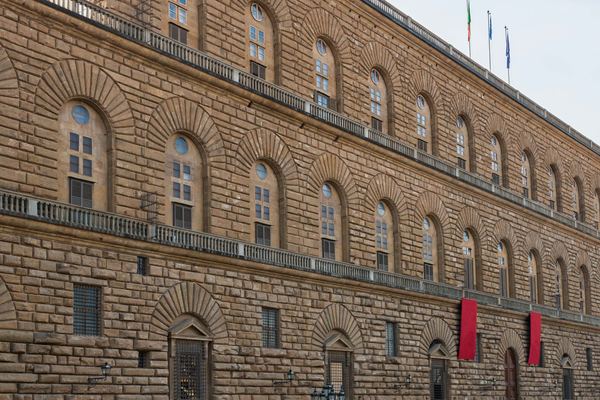
It is also the room that tells you what kind of building this is. The front on the piazza is a wall, the garden side is a stage, and the courtyard in between is where the Medici did the business of being a court. Photography is allowed throughout for personal use, without flash and without tripods; anything commercial needs written permission and a reproduction fee.
Palace and garden, month by month
Two calendars in one ticket
The museums keep the same hours every day of the year. The garden swings by nearly three hours between December and July, and it is the half of the visit that decides whether an afternoon here works.
| Month | 1 | 2 | 3 | 4 | 5 | 6 | 7 | 8 | 9 | 10 | 11 | 12 |
|---|---|---|---|---|---|---|---|---|---|---|---|---|
| Palazzo Pitti museums8:15 to 18:30 all year, Tuesday to Sunday, closed every Monday and on 1 January and 25 December. Free entry on the first Sunday of every month, at the desk only. | 1 | 2 | 3 | 4 | 5 | 6 | 7 | 8 | 9 | 10 | 11 | 12 |
| Boboli GardenOpens 8:15 all year and closes at 16:30 in January, February, November and December, 17:30 or 18:30 in spring and autumn, 19:10 in June, July and August. Last admission an hour before. Closed only the first and last Monday of the month. | 1 | 2 | 3 | 4 | 5 | 6 | 7 | 8 | 9 | 10 | 11 | 12 |
Hours from the Palazzo Pitti and Boboli Garden pages of uffizi.it, both read 2026-09-05.
The practical reading of that table is about the combined ticket, not about weather. It is valid for one day, so palace and garden have to be done together, and between November and February the garden stops admitting at half past three while the museums run to half past six. In those four months the sensible order is garden first and gallery after, which is the reverse of what almost everybody does, and it is the difference between seeing the Boboli amphitheatre and seeing a locked gate.

The Passepartout, and the order you cannot change
For anyone also doing the Uffizi, the five day Passepartout is the instrument that matters: 40 EUR for Uffizi, Palazzo Pitti and the Boboli Garden, one entry each across five consecutive days, or 58 EUR with the Vasari Corridor added. If one of those five days is a closing day, a Monday, 1 January or 25 December, the pass stretches to a sixth. Against 22 EUR for the Pitti and Boboli combination on its own, the Uffizi effectively costs 18.
There is one rule inside it that no reseller repeats, and it dictates the shape of a whole trip. The binding time slot applies only to the first entry, and that entry has to be the Uffizi: arrival fifteen minutes early, at gate 3. Only after that visit do Pitti and Boboli open up as free entries with no further booking. You cannot start on this side of the river and work back. A traveller who plans a Monday at Pitti and a Tuesday at the Uffizi has bought the pass in the wrong order twice over, because Monday is also the day the Pitti museums are shut.
What the ticket does not cover
Three things sit outside it, and two of them are the ones people expect to find. The Vasari Corridor is not in any Pitti ticket: the only way to it on this price list is the 58 EUR version of the five day pass. The Uffizi is a separate museum with a separate ticket unless the pass is doing the work. And the two extras that come free with the garden, the Bardini Garden and the Porcelain Museum, are separate sites from the palace rather than rooms inside it, so using them means a walk and a second gate, not another door off the same corridor.
There is also a documentation gap that we would rather name than paper over. The Uffizi describe a binding time slot for their own first entry on the pass, but nothing on their pages establishes whether the Pitti or the combined Pitti and Boboli ticket carries an entry time when bought online, and the ticketing portal that sells them returned no readable conditions. Nor could we find any rule on identity documents or named tickets here, which in Italy usually means there is none. If an exact hour matters to your day, the safe assumption is that the ticket does not hold one for you.
Ninety minutes is the wrong length here
The Gallerie degli Uffizi publish no recommended visit length for Palazzo Pitti or for the garden, in any of their ticket, museum or FAQ pages. The catalogue is the only evidence available, and it points one way. The best rated product here with a real sample is a 180 minute guided visit taking in the palace, the Palatine Gallery and the garden, at 98 EUR, rated 4.8 across 304 reviews. A 120 minute version at 68 EUR sits at 4.7 over 229. The 90 minute visits are where the ratings fall away: 4.5 at 69 EUR, and 4.2 at 89 EUR, which is the worst rated Florentine listing in this catalogue with a meaningful sample. The two cheapest products, a 39 EUR entry ticket with an ebook and a 59 EUR visit, are rated 4.1 and 4.0 on small numbers.
The gradient is almost linear in the length of the visit, and it is not saying that the expensive tours are better. It is saying that ninety minutes is the wrong amount of time for this building, and that the people who booked ninety minutes worked it out on the way round. One listing declares 1,440 minutes, which is how a ticket with a day's validity gets recorded, and not a day spent indoors. Fifteen of the sixteen allow free cancellation, three are private, two are small group, and only one carries skip the line in its title, which for a museum with no controlled entrance queue is about right.
One more caution about the numbers here. A single Civitatis product, a 90 minute visit to the palace and the Palatine Gallery at 72 EUR, holds 473 of the 1,238 reviews, which is 38 percent of everything this palace has collected in the catalogue, and it rates 4.6. The weighted 4.659 for this palace is largely that one product, and the sample under every other listing here is small enough that a single bad morning moves it. Read the individual review counts rather than the average.
Questions people ask about Palazzo Pitti
How much is a ticket, and is it cheaper online?
No, it is more. The palace is 16 EUR at the counter and 19 booked ahead, the Boboli Garden 10 and 13, the two together 22 and 25. The advance fee is a flat 3 EUR on every type. The reduced rate is 3 EUR, and entry is free for everybody on the first Sunday of the month.
What does the palace ticket actually include?
Six things: the Palatine Gallery with the Royal Apartments, the Gallery of Modern Art, the Museum of Fashion and Costume, the Treasury of the Grand Dukes, the Museum of Russian Icons and the Palatine Chapel. The garden ticket separately covers the Bardini Garden and the Porcelain Museum, and the 22 EUR combined ticket carries the Bardini too without naming it.
Which days are the palace and the garden shut?
The museums close every Monday, plus 1 January and 25 December. The garden is the exception in Florence: it closes only on the first and last Monday of each month, so on an ordinary Monday the garden is open while the palace is shut. Opening is 8:15 in both cases.
Is the five day Passepartout worth 40 EUR?
If the Uffizi is in the plan, yes: Pitti and Boboli alone cost 22 EUR together, so the Uffizi comes in at 18. The condition is the order. The only timed entry on the pass is the first one and it has to be the Uffizi, gate 3, fifteen minutes early; Pitti and Boboli then need no booking at all for the rest of the five days.
Is two hours enough?
Longer than most people book. The museum publishes no figure of its own, but the products here tell a consistent story: the 180 minute guided visit rates 4.8 and the 90 minute ones rate 4.2 and 4.5. Eleven of the sixteen listings finish inside two hours, and two hours is the length that generates the complaints.
Does the Firenze Card work here?
Yes, for both the palace museums and the garden, and no time slot has to be booked. Card holders do have to stop at the Pitti ticket office in the Ammannati courtyard to collect an entry coupon before going in. The card runs for 72 hours from first use and costs 85 EUR.
Are photographs allowed?
Yes, for personal or study use, across every site of the Gallerie degli Uffizi group. Flash and tripods are not allowed. Commercial photography and publication need specific authorisation and a fee, which is the standard arrangement across the Italian state museums in this catalogue.
Data verified on. Prices, inclusions and hours from the ticket, Palazzo Pitti and Boboli Garden pages of uffizi.it; card rules from firenzecard.it. Catalogue figures from the 16 listings here.